
Get Your Critical Files Back with Data Recovery Service Durham NC
When your drives fail, you need specialists who understand what your business stands to lose.
This data recovery service Durham NC offering is part of our broader Computer support and services, so you can count on us for ongoing technology assistance beyond your immediate recovery needs.
TL;DR: Your business data faces constant risk from drive failure, accidental deletion, and corruption.
Our data recovery service Durham NC retrieves files from failed hard drives, SSDs, and RAID systems with local expertise you can access directly.
You get transparent assessments, secure handling, and a team that treats your data like the asset it is.
A single drive failure can halt your operations, erase customer records, or destroy years of financial documentation. You might notice clicking sounds, inaccessible partitions, or drives that simply stop mounting. Each symptom signals a different underlying problem, and the wrong response often makes recovery harder.
Our team works with businesses throughout the Research Triangle who need files retrieved from mechanical drives, solid-state storage, and multi-disk arrays. You receive a clear evaluation of what is recoverable, the approach we recommend, and the security protocols that protect your information throughout the process.
What Happens When Your Hard Drive Fails
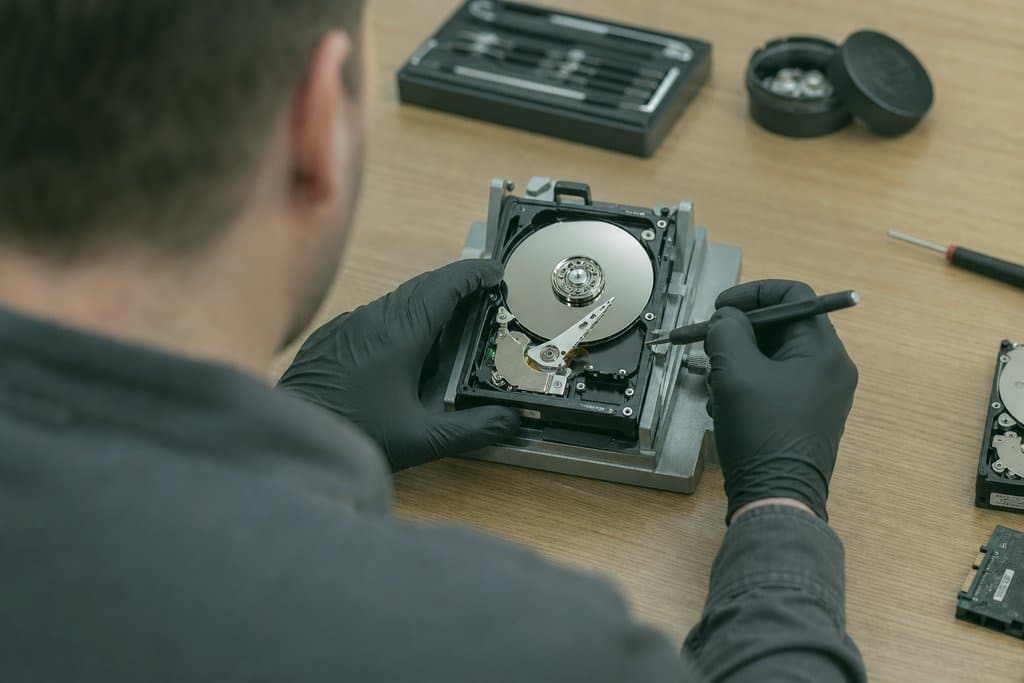
Your hard drive contains spinning platters, read/write heads, and firmware that coordinate every data access.
When any component degrades, you experience symptoms ranging from slow performance to complete unresponsiveness.
Mechanical failure often produces clicking or grinding sounds as heads struggle to locate data sectors.
Logical corruption leaves the hardware intact but scrambles the file system structure that tells your computer where documents live.
Many Durham business owners attempt DIY fixes first, downloading recovery software or swapping circuit boards between drives.
These approaches frequently compound the damage.
Software cannot repair physical head crashes, and board swaps ignore firmware calibration unique to each drive.
You need diagnostic tools that read at the firmware level and cleanroom environments for physical repairs.
Signs Your Drive Needs Professional Attention
- You hear repetitive clicking, beeping, or grinding from the drive enclosure
- Your computer BIOS no longer detects the drive at boot
- File names appear garbled or folders show as empty unexpectedly
- The drive mounts intermittently or causes system freezes during access
- You smell burning electronics or notice excessive heat from the enclosure
Recognizing these warning signs early improves your recovery prospects. Continuing to power a failing drive generates additional platter damage, potentially destroying data that remains readable today.
How You Benefit from Expert Data Recovery

Not every recovery scenario demands the same approach. Your situation determines whether we address logical file system damage, firmware corruption, or physical component failure. Our specialists match the technique to the symptoms, drawing on experience with consumer drives, enterprise SAS arrays, and specialized storage formats.
You gain several advantages working with local recovery specialists rather than shipping drives to distant facilities.
Direct communication means you speak with the technician handling your case, not a call center reading from scripts.
You can deliver media personally, eliminating shipping risks and delays.
And you build a relationship with a team that understands Durham's business landscape, from startups on Fayetteville Street to research operations near Duke and NC State.
Your Recovery Process from Start to Finish
Every engagement begins with a no-cost media evaluation.
You bring or ship your failed drive to our facility, where we assess the failure mode and determine what data remains recoverable.
You receive a detailed report outlining what we found, the recommended recovery path, and the expected outcome.
Only after you review this information do you decide whether to proceed.
This structured process protects you from spending resources on recoveries with minimal success probability. IT also ensures your data receives appropriate security handling throughout.
Here's exactly what to expect at every step, from your first call to the finished job.
You submit your media for evaluation
You submit your media for evaluation with a detailed description of the failure circumstances
Our technicians diagnose the root cause
Our technicians diagnose the root cause using specialized hardware and firmware tools
You receive a written assessment showing
You receive a written assessment showing what files are recoverable and the recommended approach
Approved recoveries proceed in appropriate environments
Approved recoveries proceed in appropriate environments, from logical workstations to certified cleanrooms
You verify recovered data before final
You verify recovered data before final delivery, ensuring the files you need are intact and accessible
Why Choose RCOR
- You hear repetitive clicking, beeping, or grinding from the drive enclosure
- Your computer BIOS no longer detects the drive at boot
- File names appear garbled or folders show as empty unexpectedly
- The drive mounts intermittently or causes system freezes during access
- You smell burning electronics or notice excessive heat from the enclosure
- Our technicians diagnose the root cause using specialized hardware and firmware tools
Why Your SSD Needs Different Recovery Techniques
Solid-state drives store data on NAND flash chips rather than magnetic platters, which changes everything about how failures occur and how you recover from them.
SSD controller failure renders the entire device inaccessible even though the underlying flash memory remains intact.
Wear-leveling algorithms spread data across chips in patterns that standard tools cannot reconstruct without manufacturer-specific knowledge.
TRIM commands, encryption integration, and proprietary compression add layers of complexity absent from traditional hard drives.
When your SSD fails, you need technicians who understand these architectures and maintain current tooling for major controller families.
Our lab handles M.2, NVMe, and enterprise U.2 formats common in modern Durham workstations and servers.
Common SSD Failure Modes You Might Encounter
- The SSD suddenly disappears from your system with no warning sounds or mechanical symptoms
- Your drive reports its full capacity but shows as uninitialized or raw format
- Firmware bugs cause the controller to enter a locked or safe mode that blocks access
- Power loss during write operations corrupts the mapping tables that locate your files
- NAND degradation produces read errors that cascade as the drive attempts background maintenance
Because SSDs give little audible warning before failure, many users discover problems only when data becomes completely inaccessible. Regular backups remain your best protection, but when those fail or lag behind, specialized recovery offers your next best path.
What You Should Know About RAID and NAS Recovery

Your multi-drive array was designed for redundancy, yet RAID failures remain one of the most complex recovery scenarios businesses face.
Multiple simultaneous drive failures, controller malfunctions, and human error during rebuild operations can all collapse arrays that were supposed to protect your data.
The interdependency between drives means each additional failure exponentially complicates reconstruction.
NAS devices add another layer, often running proprietary operating systems with unique file system implementations.
When your array goes offline, you need specialists who understand both the hardware RAID levels and the software environment managing your shares.
Our team has reconstructed arrays with damaged parity, out-of-sync mirrors, and configurations where multiple drives dropped sequentially.
RAID Recovery Scenarios We Address
- Your array reports degraded status but fails during rebuild with additional drive errors
- A power event causes the RAID controller to lose its configuration metadata
- Multiple drives show SMART errors or timeouts during intensive operations
- You accidentally initialize or reformat the array while attempting troubleshooting
- The NAS operating system fails to boot, leaving your array inaccessible through normal interfaces
Successful RAID recovery often requires imaging each drive individually before attempting array reconstruction. This protects against further degradation during the recovery process and gives our technicians multiple approaches if one path encounters problems.
How You Can Protect Your Drives Before Recovery
The moments after discovering data loss often determine whether recovery succeeds.
Your immediate response should prioritize preserving whatever remains readable on the affected media.
Power down the device rather than repeatedly attempting to access failing drives.
Each spin cycle of a mechanically compromised hard drive risks additional platter damage.
Document what you observed before failure: unusual sounds, error messages, recent power events, or software installations.
This history helps technicians identify likely failure modes faster.
If the drive contains particularly sensitive information, note any encryption or access controls in place, as these affect how recovered data is handled and delivered back to you.
Steps to Take While Awaiting Professional Evaluation
These preparatory steps do not replace professional diagnosis, but they maximize the information available when your evaluation begins. The more context you provide, the more precisely our technicians can target their initial assessment.
You get defense in depth - every layer covered, nothing left to chance.
Stop using the affected drive immediately;
Stop using the affected drive immediately; continued operation risks overwriting recoverable data
Label the drive
Label the drive with the failure symptoms and any passwords or encryption keys needed
Place the drive in an anti-static
Place the drive in an anti-static bag if available, avoiding further physical shock
Note the make
Note the make, model, and capacity for faster identification of compatible replacement parts
Your Data Security During the Recovery Process

You are entrusting your most sensitive business information to an outside team, which makes security protocols as important as technical capability.
Our facility maintains controlled access to recovery workstations and encrypted storage for all recovered data at rest.
Technicians work on your media only within these protected environments, not on general-purpose office computers.
Chain-of-custody documentation tracks your media from intake through final delivery.
You receive verification of who handled your drives, when transfers occurred, and where data resided throughout the process.
For organizations subject to internal compliance requirements, this documentation supports your audit and reporting obligations without additional effort on your part.
After you verify and accept recovered data, we perform secure erasure of any working copies created during recovery. You retain control over how long recovered information remains in our systems, with written confirmation when destruction is complete.
When Should You Seek Data Recovery Service Durham NC
Timing significantly affects recovery outcomes for most storage media. Early intervention preserves more data and often simplifies the technical approach required. Waiting until multiple drives fail or running continuous recovery attempts on degrading hardware typically reduces what remains retrievable.
You should contact recovery specialists when you first notice symptoms rather than after exhausting all self-help options. Even if you maintain backups, recovery specialists can verify backup integrity and address situations where your most recent backup proves incomplete or corrupted.
Situations Where Immediate Evaluation Helps Most
- You rely on the affected data for daily operations or customer service
- The drive contains financial records, legal documents, or proprietary research
- Backup systems failed to capture recent changes or show their own errors
- Multiple users or systems depend on shared storage that has become inaccessible
- The failure occurred alongside other system events that might indicate broader infrastructure problems
Our local presence means you can often deliver media the same day you discover problems, eliminating shipping delays that extend downtime. For urgent situations, you reach technicians directly rather than waiting for callback queues or ticket escalation.
Your Recovery Options for Different Drive Types

The storage technology in your failed device determines both the failure modes you experience and the recovery approaches available.
Traditional hard drives remain common in bulk storage, backup systems, and older workstations.
Their mechanical nature makes physical failures audible and often recoverable through component-level repair in appropriate environments.
Solid-state storage dominates laptops and high-performance desktops, offering speed without moving parts but introducing complexity through controllers and wear management.
Hybrid drives combine both technologies, requiring technicians competent in mechanical repair and flash recovery.
Understanding which technology you have helps set appropriate expectations for timeline and outcome.
Our lab maintains current capabilities across all major storage formats, including emerging technologies. You receive honest assessment of whether your specific device falls within our current recovery scope, with referrals to specialized partners when appropriate.
Questions You Might Have About Data Recovery
Business owners often want to understand the recovery process before committing their media to evaluation. The following questions reflect what Durham clients most frequently ask when first contacting our team.
Who this is for
If your business is one of these, you already know what good support looks like.
Do you work near RCOR?
Find your town on the list - if you're in reach, you're covered.
What RCOR clients say
★★★★★ 5.0 from 7 Google reviews
I met Tim at a trade show last year and he's an awesome guy and very passionate about his business and his clients that much I can tell you. He also gave me a tour of their office recently and it's impressive!
We have used RCOR for many years and look to them as a partner. They are reliable and provide incredible service. Responsive and solve all of our IT issues. We would not use anybody else and highly recommend them.
I have worked with Brad from RCOR primarily the past couple of years. He is fantastic!-- kind, calm and tackles the problem until it is solved. Thank you for taking care of all of our IT needs!
Very responsive Kind No complaints from Happy Client
We have been using Tim and Brad at RCOR for about a year now at our business and we have been amazed at the quality of the IT support we have received. Any time we have run into an IT issue, they are immediately responsive and if they aren't able to solve an issue over the phone, they are quick to arrive at our offices to problem-solve. The peace of mind that they provide us, knowing that any issue we encounter will be solved efficiently, is invaluable!! It's a bonus that they both are just super pleasant to work with. We love having them on our team! Thanks, Tim and Brad!!

Response promise

Google rating

Five-star reviews

Communities served
Explore these services
Jump straight to any service on this page.
See the RAID array recovery page for what's included, typical timelines, and the questions we hear most.
See the Encrypted drive recovery page for what's included, typical timelines, and the questions we hear most.
Need Data recovery? That page lays out the scope, common questions, and next steps.
Digital Permanence Best Practices explains how organizations can protect important electronic records through backups and offsite storage.
Get Started
Ready to recover your critical files? Call (919) 263-5570 or visit to speak with a recovery specialist about your situation.
IT support built around your business

Computer security service
Get computer security service in Durham, NC with managed security, compliance-focused cybersecurity, and 24/7 monitoring. Local experts protect your business.

Computer consultant
Work with a computer consultant Durham NC businesses trust for hands-on IT strategy, system planning, and ongoing technology guidance.

Computer support and services
Computer support and services Durham NC businesses trust for fast tech support, skilled computer technician help, and dependable repair services.

VoIP setup
Professional VoIP setup in Durham NC for businesses ready to upgrade their phone systems. Local support, cloud flexibility, and clear call quality.
Why the Triangle Trusts RCOR
Google review
We have used RCOR for many years and look to them as a partner. They are reliable and provide incredible service. Responsive and solve all of our IT issues. We would not use anybody else and highly recommend them.
Google review
I have worked with Brad from RCOR primarily the past couple of years. He is fantastic!-- kind, calm and tackles the problem until it is solved. Thank you for taking care of all of our IT needs!
Google review
Very responsive Kind No complaints from Happy Client
Google review
Questions
Frequently Asked Questions
Timelines vary by site complexity and failure type. Logical recoveries may conclude within days, while physical repairs requiring cleanroom work or donor parts extend based on component availability. You receive updated estimates after initial evaluation.
Physical trauma and liquid exposure both complicate recovery but do not automatically prevent it. Evaluation determines whether platter damage, corrosion, or component failure has occurred. We assess these cases in controlled environments designed for compromised media.
Our evaluation carries no cost. You decide whether to proceed with recovery only after receiving a complete assessment of what is retrievable and the recommended approach. No surprise charges appear if you choose not to move forward.
Your information receives protected handling throughout the process. Controlled access environments, encrypted storage, and documented chain-of-custody protect your data. Working copies are securely erased after you verify and accept your recovered files.
Yes. External enclosures, USB-connected drives, and portable SSDs all fall within our recovery scope. The interface does not change the underlying recovery challenge; it merely affects how we initially access the media for diagnosis.
I met Tim at a trade show last year and he's an awesome guy and very passionate about his business and his clients that much I can tell you. He also gave me a tour of their office recently and it's impressive!