
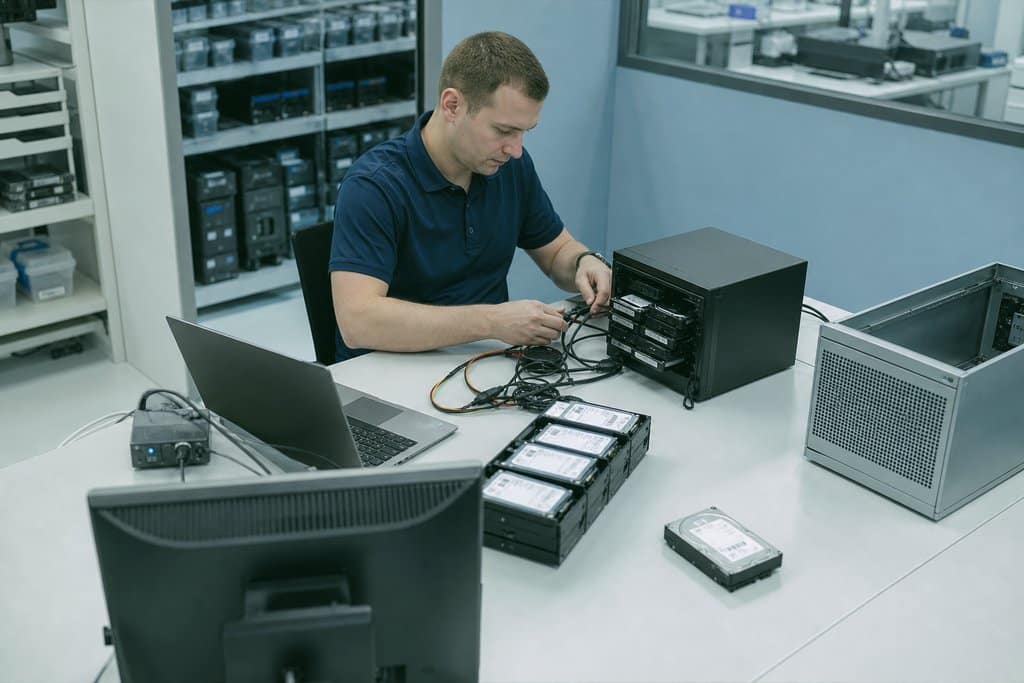
Your RAID Array Recovery Durham NC Starts Before Failed RAID Arrays Cost You Everything
When multiple drives fail or your array goes offline, you need specialists who understand striped data, parity rebuilds, and the urgency of your situation.
If you are also facing other storage challenges, you will find that this RAID work sits within our broader Data recovery service offering, where we address everything from single-drive failures to complex enterprise storage systems.
TL;DR: If your RAID array recovery in Durham, NC cannot wait, our engineers assess failed RAID arrays, extract hard drive data from degraded sets, and rebuild logical volumes without forcing you into risky DIY rebuilds that destroy remaining parity.
You built your RAID setup for redundancy, not for the day when two drives fail during a rebuild or your controller drops the entire logical disk.
When that moment arrives, every decision you make either preserves recoverable data or buries IT deeper under overwritten parity stripes.
Our team works with businesses and professionals across the Research Triangle who cannot afford to treat drive data recovery as a learn-as-you-go experiment.
We see the same patterns repeatedly: a single failing drive gets ignored because the array still mounts, then a second drive develops read instability during the automatic rebuild, and suddenly the entire volume presents as raw or unallocated space.
The panic that follows is understandable, but the response matters more than the failure itself.
This page explains what you should know about protecting your hard drive data, why failed RAID arrays behave differently from single-drive failures, and how professional intervention changes the outcome.
What Happens When Your RAID Array Starts Failing
Your RAID controller hides individual drive problems until the redundancy threshold breaks.
A RAID 5 volume tolerates one complete drive failure, but not a second failing drive that develops bad sectors during rebuild.
A RAID 6 volume tolerates two failures, yet read instability on a third drive can still stall parity calculations indefinitely.
The failing drive you notice today may already have companions showing early warning signs.
Controllers manage this complexity through metadata: stripe maps, parity algorithms, disk order tables, and sometimes proprietary extensions.
When the controller firmware encounters unreadable sectors during a rebuild, it must decide whether to mark the block bad, attempt recovery, or abort the entire operation.
Consumer-grade controllers often choose the nuclear option and drop the array, leaving you with multiple physically intact drives that collectively contain unmountable data.
Why Your Array Status Light Means Less Than You Think
Green LEDs indicate electrical presence, not data integrity.
A drive can spin, respond to SMART polls, and still return corrupted sectors that poison parity calculations.
The hard drive data you need may sit on drives that appear healthy to casual inspection.
Professional assessment reads each drive at the sector level, logs every read error, and determines whether the array can be reconstructed logically or whether individual drives need physical intervention first.
- RAID metadata corruption from unexpected power loss or firmware bugs
- Partial rebuilds that overwrite good data with incomplete parity
- Drive order confusion after hot-swap attempts without documentation
- Controller migration that fails to import foreign configuration
- Multiple simultaneous drive failures from shared environmental stress
How Failed RAID Arrays Differ From Single-Drive Recovery

Single-drive recovery follows a linear path: image the drive, identify the file system, extract logical files.
Failed RAID arrays add combinatorial complexity.
You must determine stripe size, parity rotation, disk order, and whether the array used delayed parity, adaptive stripe size, or proprietary extensions.
A five-drive RAID 5 set has 120 possible disk order permutations, and each permutation must be tested against multiple stripe sizes and parity algorithms.
The recovery environment must also handle degraded states gracefully.
If one drive is completely unreadable, the engineer must reconstruct its data from parity while compensating for any bad sectors on the remaining drives.
This requires computational resources and software flexibility that consumer tools rarely provide.
The drive data recovery process for arrays is as much about mathematical reconstruction as it is about physical drive repair.
When Rebuilding Yourself Destroys Recoverable Data
The most common self-inflicted damage we encounter is the forced rebuild.
A user replaces one drive, starts the rebuild, and the process fails partway through because a second drive cannot sustain read throughput.
The controller may then mark the second drive failed, leaving the array in a state where original parity has been partially overwritten and original data stripes are compromised.
What began as a recoverable two-drive problem becomes a multi-layer data loss scenario.
Another frequent error is importing drives into a different controller model.
Each manufacturer stores metadata differently, and cross-importing can overwrite critical array parameters.
Even same-brand controllers from different product generations may use incompatible metadata formats.
The raid array recovery durham process must begin with complete drive imaging before any reassembly attempts, preserving every bit of original state for analysis.
Signs Your Hard Drive Data Is at Risk in a RAID Setup
Early warning signs of array trouble often masquerade as performance issues.
Sustained write speeds drop because the controller retries failed writes.
Read operations stall while the controller attempts sector recovery on a marginal drive.
Applications time out waiting for I/O completion that should complete in milliseconds.
These symptoms indicate that your failing drive is consuming the controller's error-correction budget.
Log files reveal more if you know where to look.
Controller event logs record medium errors, predictive failures, and rebuild initiations.
Operating system logs show filesystem delays and I/O timeouts.
SMART data from individual drives, when accessible through the controller's pass-through mode, reveals reallocated sector counts, pending sectors, and offline uncorrectable errors.
The pattern across multiple drives matters more than any single metric.
Environmental Factors That Accelerate Array Degradation
RAID arrays share power supplies, cooling systems, and vibration environments.
A power supply producing voltage ripple affects all drives simultaneously.
Insufficient cooling raises temperatures across the entire set, accelerating mechanical wear.
Rack-mounted servers transmit vibration between adjacent drives, amplifying head positioning errors.
These shared stressors explain why failed RAID arrays often experience multiple drive problems in clusters rather than isolated random failures.
- Consistent slowdowns during previously routine operations
- Unexplained array verification or consistency checks that run repeatedly
- Drive dropout and reappearance in management interfaces
- Audible changes in drive seek patterns or increased vibration
- Temperature alerts that persist after cleaning dust filters
What Your RAID Array Recovery in Durham, NC Actually Involves

Professional recovery begins with stabilization, not extraction.
Each drive receives individual assessment in controlled conditions.
Drives with mechanical problems head to cleanroom environments for platter-level work.
Drives with firmware issues receive targeted fixes that restore communication without altering user data.
Only after every possible drive is imaged does the logical array reconstruction begin.
The reconstruction phase treats your array as a mathematical puzzle with physical constraints.
Engineers determine stripe size by analyzing repeating patterns in the raw sector data.
They identify parity rotation by locating consistent checksum relationships.
They verify disk order by checking filesystem metadata continuity across stripe boundaries.
This analytical approach to hard drive data recovery avoids the guesswork that damages recoverable structures.
How We Handle Proprietary and Nested RAID Configurations
Modern storage complicates recovery with nested levels: RAID 10 combines mirroring and striping, RAID 50 nests RAID 5 sets inside a RAID 0 stripe, and RAID 60 doubles the nesting.
Some manufacturers implement proprietary variants with non-standard parity or distributed hot spares.
Software RAID from operating systems adds another layer of metadata interpretation.
Each variation requires specific knowledge and flexible tools.
Network-attached storage units often embed RAID within encrypted volumes or proprietary filesystems.
The drive data recovery process must decrypt or interpret these layers before files become accessible.
Our engineers maintain current knowledge of major NAS platforms and their recovery characteristics, ensuring that your array reconstruction produces usable results rather than technically correct but inaccessible data.
Why Local Response Matters for Your Failing Drive Situation
Array failures create decision pressure.
Every hour of downtime carries operational cost, and the temptation to attempt quick fixes grows with each passing minute.
Local access to recovery engineering changes this dynamic.
You can deliver drives directly, discuss findings in person, and make informed decisions without the delays and shipping risks of remote services.
Durham's position in the Research Triangle means many clients operate hybrid environments: on-premise arrays for performance-critical workloads, cloud synchronization for accessibility, and tape or archival storage for compliance.
When the primary array fails, these interdependencies amplify urgency.
Local raid array recovery durham capability means you can restore the central storage component while maintaining the broader data management architecture.
What Direct Engineer Access Means for Complex Cases
Some recoveries require iterative decision-making.
Imaging reveals unexpected encryption; reconstruction finds non-standard stripe geometry; extracted data shows corruption patterns suggesting a different failure sequence.
Phone and email communication handles routine cases, but complex failed RAID arrays benefit from direct collaboration.
You sit with the engineer, review intermediate results, and adjust priorities based on what the data reveals.
This collaborative approach also serves compliance requirements.
Healthcare providers, financial services, and research institutions often need documented chain of custody, witnessed procedures, or specific security protocols.
Local presence makes these arrangements practical rather than theoretical.
Your failing drive never leaves your oversight until you understand exactly what happened and what was recovered.
How You Should Respond When RAID Failure Strikes

Immediate response protocols determine recovery feasibility.
The first rule is counterintuitive: stop trying to make the array work.
Every additional power cycle, rebuild attempt, or configuration change risks overwriting metadata or stressing already marginal drives.
Document what you observe, then power down cleanly if the array is still accessible, or leave IT powered off if it is not.
Second, preserve the physical arrangement.
Note drive positions, cable connections, and controller slot assignments.
Photograph the setup before disconnecting anything.
This documentation becomes critical during reconstruction, especially for arrays that have evolved through multiple maintenance events without updated records.
The hard drive data you recover depends partly on how accurately the original configuration can be reproduced.
Information That Speeds Your Assessment
When you contact recovery services, specific details enable faster and more accurate guidance.
The array level and approximate drive count matter.
The failure sequence, to the best of your knowledge, helps predict recovery complexity.
The controller model and any recent firmware changes provide context.
Whether the array was encrypted, compressed, or deduplicated affects the reconstruction approach.
- Array level, drive count, and approximate capacity per drive
- Controller or NAS model and firmware version
- Sequence of observed failures and any error messages
- Recent changes: firmware updates, drive replacements, power events
- Whether backups exist and what they cover
- Critical data priority if full recovery proves impractical
What Recovery Outcomes You Can Realistically Expect
No ethical professional promises specific results before assessment.
What we can describe is the range of outcomes we observe and the factors that influence them.
Complete recovery of all data with original directory structures occurs when drives are imaged successfully and array parameters are correctly identified.
Partial recovery happens when one or more drives have extensive unreadable sectors, but parity allows reconstruction of the majority of stripes.
Corruption patterns emerge when rebuild attempts or write operations have modified original data before professional intervention.
These cases require file-level carving and logical repair rather than simple array reassembly.
The drive data recovery process adapts to each situation, prioritizing your most critical files when complete restoration is not achievable.
Transparency about these possibilities allows you to make informed decisions about proceeding.
How Recovery Complexity Maps to Timeline Variables
Simple two-drive mirrors with one failed member may resolve in hours if the remaining drive is healthy.
Complex RAID 6 arrays with multiple failing drives, especially where drives require physical repair before imaging, extend to days.
Each additional variable, encryption layer, or proprietary extension adds analytical time.
We communicate progress at meaningful intervals so you can plan around the work rather than waiting blindly.
The failing drive that seems most problematic is not always the critical path.
Sometimes a drive with complete mechanical failure can be repaired to functional imaging condition, while a drive with intermittent firmware faults requires dozens of retry iterations to complete.
Recovery scheduling accounts for these uncertainties, with parallel work streams where possible and sequential dependencies where necessary.
How to Protect Your Array After Recovery

Recovery is not the end of the story.
The conditions that caused your original failure may still exist: aging drives, inadequate cooling, power quality issues, or controller vulnerabilities.
Addressing these prevents recurrence and protects the investment you have made in professional recovery.
We provide specific observations about contributing factors when our assessment reveals them.
Array design also deserves review.
RAID is not backup; IT protects against specific hardware failures but not against deletion, corruption, malware, or site disasters.
Your hard drive data strategy should include point-in-time copies, offsite protection, and verification that restoration procedures actually work.
Many organizations discover backup deficiencies only during the crisis that exposes them.
Monitoring Practices That Catch Problems Early
Proactive monitoring transforms catastrophic surprises into manageable maintenance events.
SMART polling with appropriate thresholds alerts you to individual drive degradation before it affects array operation.
Controller health checks verify battery backup unit status, cache integrity, and firmware consistency.
Environmental monitoring tracks temperature trends, power events, and vibration levels that stress mechanical components.
For critical arrays, consider hot spares and automated rebuild with notification rather than manual intervention.
The time between first drive failure and replacement initiation often determines whether a second failure becomes catastrophic.
The raid array recovery durham cases we see most frequently involve delays in this window, whether from unavailable replacement drives, staffing gaps, or simply missing the initial alert.
Is your industry on the list?
These are the businesses that count on RCOR - see if yours is one.
Do you work near RCOR?
Find your town on the list - if you're in reach, you're covered.
What RCOR clients say
★★★★★ 5.0 from 7 Google reviews
I met Tim at a trade show last year and he's an awesome guy and very passionate about his business and his clients that much I can tell you. He also gave me a tour of their office recently and it's impressive!
We have used RCOR for many years and look to them as a partner. They are reliable and provide incredible service. Responsive and solve all of our IT issues. We would not use anybody else and highly recommend them.
I have worked with Brad from RCOR primarily the past couple of years. He is fantastic!-- kind, calm and tackles the problem until it is solved. Thank you for taking care of all of our IT needs!
Very responsive Kind No complaints from Happy Client
We have been using Tim and Brad at RCOR for about a year now at our business and we have been amazed at the quality of the IT support we have received. Any time we have run into an IT issue, they are immediately responsive and if they aren't able to solve an issue over the phone, they are quick to arrive at our offices to problem-solve. The peace of mind that they provide us, knowing that any issue we encounter will be solved efficiently, is invaluable!! It's a bonus that they both are just super pleasant to work with. We love having them on our team! Thanks, Tim and Brad!!

Response promise

Google rating

Five-star reviews

Communities served
Consult the Microsoft RAID repair documentation for instructions on repairing a RAID five volume after disk failure.
Get Started
When your array fails, every hour of delay increases risk. Call (919) 263-5570 now to discuss your RAID array recovery in Durham, NC with an engineer who understands the urgency of your situation, or visit to arrange secure drive delivery and assessment.
IT support built around your business

Firewall installation
Professional firewall installation in Durham, NC by local network engineers. Protect your business or smart home with integrated security solutions built for

Data migration
Professional data migration in Durham, NC. Protect data integrity and quality during secure transfers. Local experts manage your move from start to finish.

Disaster recovery planning
Disaster recovery planning Durham NC services help your business prepare for outages, cyber events, and natural disruptions with tested recovery frameworks.

Threat detection
Get 24/7 threat detection in Durham, NC from RCOR. Proactive monitoring, rapid incident response, and local security operations protect your business.
Why the Triangle Trusts RCOR
Google review
We have used RCOR for many years and look to them as a partner. They are reliable and provide incredible service. Responsive and solve all of our IT issues. We would not use anybody else and highly recommend them.
Google review
I have worked with Brad from RCOR primarily the past couple of years. He is fantastic!-- kind, calm and tackles the problem until it is solved. Thank you for taking care of all of our IT needs!
Google review
Very responsive Kind No complaints from Happy Client
Google review
Questions
Frequently Asked Questions
Multiple factors converge: aging drives operated beyond their design life, inadequate cooling in compact server closets, power events without adequate protection, and delayed response to initial drive warnings. The shared environment of array components means problems propagate rather than isolate.
RAID 5 cannot tolerate two complete failures natively, but recovery depends on the failure mode.
If one drive is completely dead and the second has partial readability, sector-level imaging plus parity reconstruction may recover significant data.
Complete recovery becomes impossible only when the second failure eliminates too much unique data or parity information.
Single-drive recovery works with one filesystem on one device. RAID recovery must first reconstruct the virtual device from multiple physical drives with interleaved data, then interpret the filesystem on that reconstructed volume. The combinatorial complexity of stripe parameters makes automated guessing unreliable for non-trivial cases.
Document the current state without making changes.
Note which drive shows errors, capture any controller messages, and avoid rebuild attempts until you understand the full situation.
If the array is still operational, verify your most recent backups before taking any action that might stress marginal components.
Yes, though the specific approach varies by manufacturer. Proprietary RAID implementations embed standard mathematical structures within custom metadata formats. Successful recovery requires understanding both the underlying RAID mechanics and the manufacturer’s specific extensions, which our engineers maintain through ongoing platform study.
I met Tim at a trade show last year and he's an awesome guy and very passionate about his business and his clients that much I can tell you. He also gave me a tour of their office recently and it's impressive!