A cyberattack on a Raleigh business rarely starts with the dramatic moment most owners picture. It usually begins with a quiet misconfiguration, an exposed admin panel, or a single reused password that an attacker found weeks before anyone noticed.
Penetration testing is how you find those weaknesses before someone else does, on your schedule and with a written plan. This guide walks through what a pen test actually involves for Raleigh and Durham companies, what it costs, why your insurance carrier may already be asking for one, and how to read the report you get at the end.
Key Takeaways
- A pen test is a hands-on, manual simulation of a real attack, not just an automated scan, and the deliverable includes reconnaissance, exploitation, and a written report you can hand to an insurer or auditor.
- The three engagement types Raleigh businesses most often need are external network, web application, and social engineering, and each has its own scope, timeline, and price band.
- Cyber insurance carriers now treat a recent pen test as a baseline underwriting requirement, and roughly 25 percent of businesses were denied coverage in 2024 for lacking verifiable testing.
- A typical external network pen test for a Raleigh small or mid-size business runs $5,000 to $20,000, with internal and web application engagements priced separately based on scope and complexity.
Why Penetration Testing Matters for Raleigh Businesses
Raleigh has become a target-rich environment for cybercriminals over the past five years, with growing concentrations of fintech, biotech, defense contractors, healthcare practices, and professional services across the Triangle. Local incident data backs that up, with a 2024 attack on the Town of Apex alone exposing the personal information of nearly 22,000 residents through a compromised third-party cloud provider.
Statewide, North Carolina reported 1,215 data breach incidents in 2024, up from 843 the prior year, and ransomware drove more than half of them. The financial impact lands hardest on small and mid-size businesses, where roughly 60 percent of organizations never fully recover from a major breach.
A penetration test is the most direct way to find out whether your defenses would actually stop one of those attacks. It does not predict the future, but it does turn a long list of theoretical risks into a short list of provable, exploitable problems your team can prioritize and fix.
Strong data protection also depends on how information is handled from creation through disposal, which is why many Raleigh businesses are now focused on Overcoming Key Challenges In Data Lifecycle Management as part of their broader security strategy.
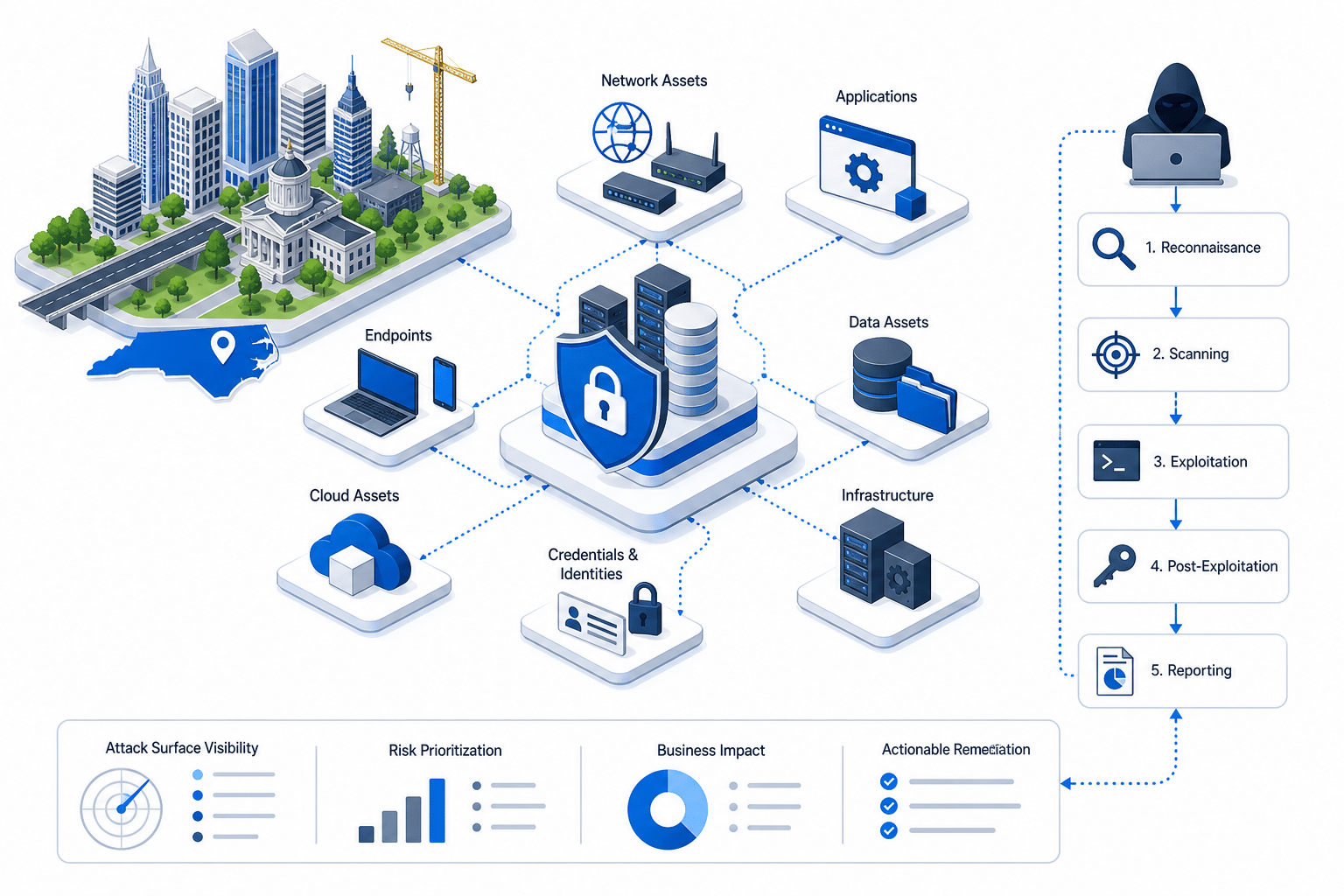
Penetration Testing by the Numbers: What Raleigh Businesses Should Know
Sources: IBM Cost of a Data Breach Report 2024, Marsh McLennan 2024, North Carolina Attorney General 2024 Data Breach Report, TCM Security and Compass IT Compliance 2025 pricing surveys, Pentera State of Pentesting, Microsoft MFA research.
Pen Test vs. Vulnerability Assessment: The Difference Matters
These two terms get used interchangeably, and that confusion costs Raleigh businesses real money every renewal cycle. A vulnerability scan is an automated check that produces a list of known weaknesses ranked by severity, often with significant false positives mixed in.
A penetration test starts where the scanner stops, with a trained human attempting to chain those weaknesses into actual access. Pen testers verify which findings are exploitable, demonstrate impact with proof of concept, and discard the noise that wastes your IT team’s time on issues no real attacker would bother with.
Both have a place in a mature security program, and good providers run both during a single engagement. The danger is paying for a low-cost vulnerability scan and being told it is a manual penetration test, which is a common pattern in offers priced below $2,500.
The Five Phases of a Pen Test, Explained
Most reputable pen testing services follow a five-phase methodology built on the OWASP, PTES, and NIST SP 800-115 frameworks. The phases are reconnaissance, scanning, vulnerability assessment, exploitation, and reporting, with each phase producing artifacts the tester uses in the next step.
Reconnaissance is the information gathering phase, where the tester maps your public footprint through OSINT, DNS records, and exposed metadata, often without ever touching a live system. Scanning then probes that footprint with tools like Nmap and Burp Suite to enumerate live hosts, open ports, running services, and the technology stack behind them.
Exploitation is the heart of the engagement, where the tester attempts to bypass controls, escalate privileges, and move laterally inside your environment using the access they have already established. Done correctly, exploitation produces evidence such as annotated screenshots, captured credential hashes, and sanitized data samples, all collected without disrupting production workloads.
Reporting is the deliverable you actually pay for and the document an insurer or auditor will ask to see. A good report includes an executive summary written for non-technical readers, technical findings with reproduction steps, a proof of concept for each exploited issue, and remediation guidance prioritized by business risk.

Common Pen Test Types for Raleigh and Durham Companies
External network testing simulates an outside attacker hitting your firewalls, VPN endpoints, email servers, and other internet-facing systems. It is the most common starting point for a first-time engagement and the one cyber insurance underwriters ask about most often.
Internal network testing assumes the attacker is already inside, usually through a stolen laptop, a phished employee, or a third-party vendor connection. The tester typically focuses on Active Directory abuse, privilege escalation, and how far they can move once they have any foothold at all.
Web application testing targets your customer portals, internal admin tools, and APIs for issues like SQL injection, broken access control, insecure direct object references, and authentication flaws. A typical engagement runs roughly a week per application and produces deeper, more business-specific findings than a pure network test.
Social engineering tests your people, not your firewalls, through phishing, vishing, or pretexting attempts that try to harvest credentials or trigger wire fraud. For most Raleigh small businesses, a focused phishing simulation against a sample of employees is the lowest-cost addition and frequently produces the most surprising results in the final report.
Why Cyber Insurance Carriers Now Require Pen Tests
Cyber insurance underwriting changed dramatically between 2020 and 2024, after ransomware claims outpaced premiums and carriers began losing money on the line. The market response was risk-based underwriting that no longer accepts a self-attested questionnaire as adequate evidence of security.
Marsh McLennan reported in 2024 that 25 percent of businesses applying for coverage were denied because they could not produce verifiable security testing. Carriers now expect an annual penetration test report on file, with remediation evidence for any high-severity findings the test surfaced.
Automated vulnerability scans, even good ones, will not satisfy most underwriters at the renewal table. Manual, human-led testing is the standard insurers actually trust, and the report format matters because it has to be readable by an underwriter who is not a security engineer.
The financial upside is real beyond just qualifying for a policy. Carriers commonly tie premium discounts to clean test results, and documented remediation cycles often shave double-digit percentages off renewal pricing for businesses in finance, healthcare, and professional services.
What Penetration Testing Costs in the Raleigh Market
Pen testing pricing in 2025 reflects the manual labor involved, the scope of systems in play, and the seniority of the testers signing the report. Industry surveys put the average standard pen test between $10,000 and $35,000, with a typical Raleigh small business engagement landing closer to the lower end of that band.
External network tests usually start around $5,000 and can run to $20,000, depending on public IP count, employee headcount, and any social engineering add-on. Internal network engagements are more expensive at $7,500 to $30,000 because they often require an on-site device, badge access, or short travel for the testing team.
Web application tests fall between $5,000 and $30,000 per application, with $12,500 cited as a median benchmark in 2025 vendor pricing surveys. Cloud, API, and mobile engagements can push higher when complexity, multiple user roles, payment flows, or third-party integrations are inside the scope.
Be cautious with quotes far below these ranges, because very cheap pen tests are typically automated scans relabeled as manual testing. A useful sanity check during procurement is to ask how many tester-days the engagement actually includes, who is signing the final report, and whether retesting is built into the fixed price.
How to Prepare Your Raleigh Business for a Pen Test
Preparation work before the engagement keeps both the cost and the scope sane. The biggest preparation items are scoping, asset inventory, point-of-contact assignment, and a clear decision about whether testing will occur during business hours, off hours, or a mix of both.
A precise scope, listing specific IPs, domains, applications, and user roles, prevents the tester from wasting hours on assets that are not yours or are already deprecated. A good provider will push back if your scope is too broad for the budget, or too narrow to produce findings that meaningfully reflect your risk.
You should also decide whether the test will be unannounced or coordinated with your IT team, because each approach answers a very different question. A coordinated test measures the security of the systems themselves, while an unannounced or covert test also measures how quickly your detection and response team notices a real intruder.
Finally, line up a clear remediation path before the report lands on your desk. Knowing in advance who patches the firewall, who fixes the web app, and who briefs the executive team turns the report from a stressful document into a manageable project plan.
How to Choose a Pen Testing Partner in the Triangle
Certifications, sample reports, and references matter more than glossy marketing pages and dashboard mockups. Look for testers with credentials such as OSCP, OSCE, CREST, or GPEN, and ask to see a sanitized sample report from a recent engagement before signing anything.
Local presence in the Raleigh Durham area is useful for internal engagements that require an on-site device, badge access, or in-person social engineering. It also matters when your insurer, attorney, or compliance auditor wants to talk through findings on a follow-up call in your time zone.
Confirm that retesting is included or available at a meaningful discount after you remediate the findings. Fixing the vulnerabilities is the actual goal of the exercise, and a retest gives you the documentation insurers and regulators increasingly expect to see attached to the original report.
Finally, ask the provider how they handle data they collect during the engagement, including how long they keep evidence and how it is encrypted in storage. A serious firm will give you a clear, written answer that satisfies your legal and compliance teams without a follow-up email.
Frequently Asked Questions
How often should a Raleigh business run a penetration test?
Most cyber insurers and compliance frameworks expect at least one full penetration test per year. You should also schedule a fresh test after major infrastructure changes, a new web application launch, an office move, an acquisition, or any significant security incident that exposed gaps in your defenses.
How long does a pen test take from kickoff to final report?
A typical small to mid-size engagement runs two to three weeks end to end. That usually breaks down as a few days of pre-engagement and scoping, one to two weeks of active testing and exploitation, and another three to four days for reporting, internal QA review, and the debrief call.
Will a penetration test disrupt our production systems or take services offline?
A properly scoped test is designed to avoid downtime, and reputable testers coordinate any high-risk actions with your IT lead in real time. Most engagements explicitly exclude denial of service testing by default, and risky steps such as password spraying or exploitation of unpatched production systems are timed for off hours when possible.
Do we still need a pen test if we already do regular vulnerability scanning?
Yes, the two services answer different questions and are not interchangeable. Scans find known vulnerabilities at scale, while a pen test confirms which of those vulnerabilities a skilled attacker could actually chain into real access, which is precisely what cyber insurers and regulators ask to see documented.
What credentials should we look for in a Raleigh pen testing provider?
Look for OSCP, OSCE, CREST, or GPEN on the individual testers who will be on your engagement, and SOC 2 Type II attestation on the firm itself. You should also ask for a sanitized sample report, two recent client references in similar industries, and a clear written answer on whether retesting is included in the quoted price.

About the author
Tim Richter - Co-Founder / President
Tim Richter is Co-Founder and President of RCOR, a managed IT and cybersecurity firm that has been serving businesses across Raleigh and Durham since 1992. He brings more than 35 years in the IT industry and today leads a team providing enterprise-class network support to small and mid-sized organizations throughout the Research Triangle.