

Raleigh’s construction boom shows no sign of slowing, with Wake and Mecklenburg counties combined adding nearly 194,000 people since 2020 and a $387 million project to expand the Raleigh Convention Center and relocate the Red Hat Amphitheater now in the pipeline. That growth puts unique pressure on local contractors, whose teams now work across muddy jobsites, temporary trailers, and headquarters offices while juggling tighter schedules and more sophisticated technology.
RCOR works with construction companies across Raleigh, Durham, Cary, and the broader Triangle to solve the technology problems that office-only IT firms tend to miss. This guide walks through the jobsite connectivity, mobile device, software, and security issues that affect Raleigh contractors, and what a construction-aware IT partner does about them.
Key Takeaways
- Jobsite Wi-Fi failures are the single biggest source of field productivity loss for Raleigh contractors, with most issues tied to single-carrier cellular hotspots, poor trailer placement, or no failover in place.
- Rugged tablets and phones running Procore, Autodesk Build, or PlanGrid need centralized mobile device management, not BYOD chaos, to stay secure on shared subcontractor networks.
- Construction is now one of the most ransomware-targeted sectors in the economy, and most attacks start with a phishing email aimed at an estimator, PM, or accounts payable clerk.
- A construction-specific IT partner should support both the office and the trailer, including same-day field visits, device management, and compliance documentation for OSHA, DOT, and Davis-Bacon work.
Why Raleigh Construction Firms Need Specialized IT Support
The Triangle is one of the fastest growing construction markets in the country, with Raleigh standing out for one of the highest rates of new construction at a 4.8% increase in new builds, on the back of 5.12% population growth in 202 4. Wake County continues to anchor that growth, and Raleigh-Cary recently ranked as the 10th fastest-growing metro area in the country per U.S. Census Bureau d
ata.
That growth means more jobs, more crews, and more technology per crew than five years ago. A small commercial GC in Raleigh now runs Procore, Sage 300 CRE, fleet GPS, drone capture, and a dozen subcontractor apps, often from a job trailer two miles from the nearest fiber line.
Most general purpose Raleigh IT firms are built around office desks and conference rooms. They are not staffed to roll a truck to a muddy site off Capital Boulevard at 7 in the morning to fix a failed cellular bridge before the concrete pour starts.
That gap is what construction focused IT is for. The work has to follow the project, not the desk.
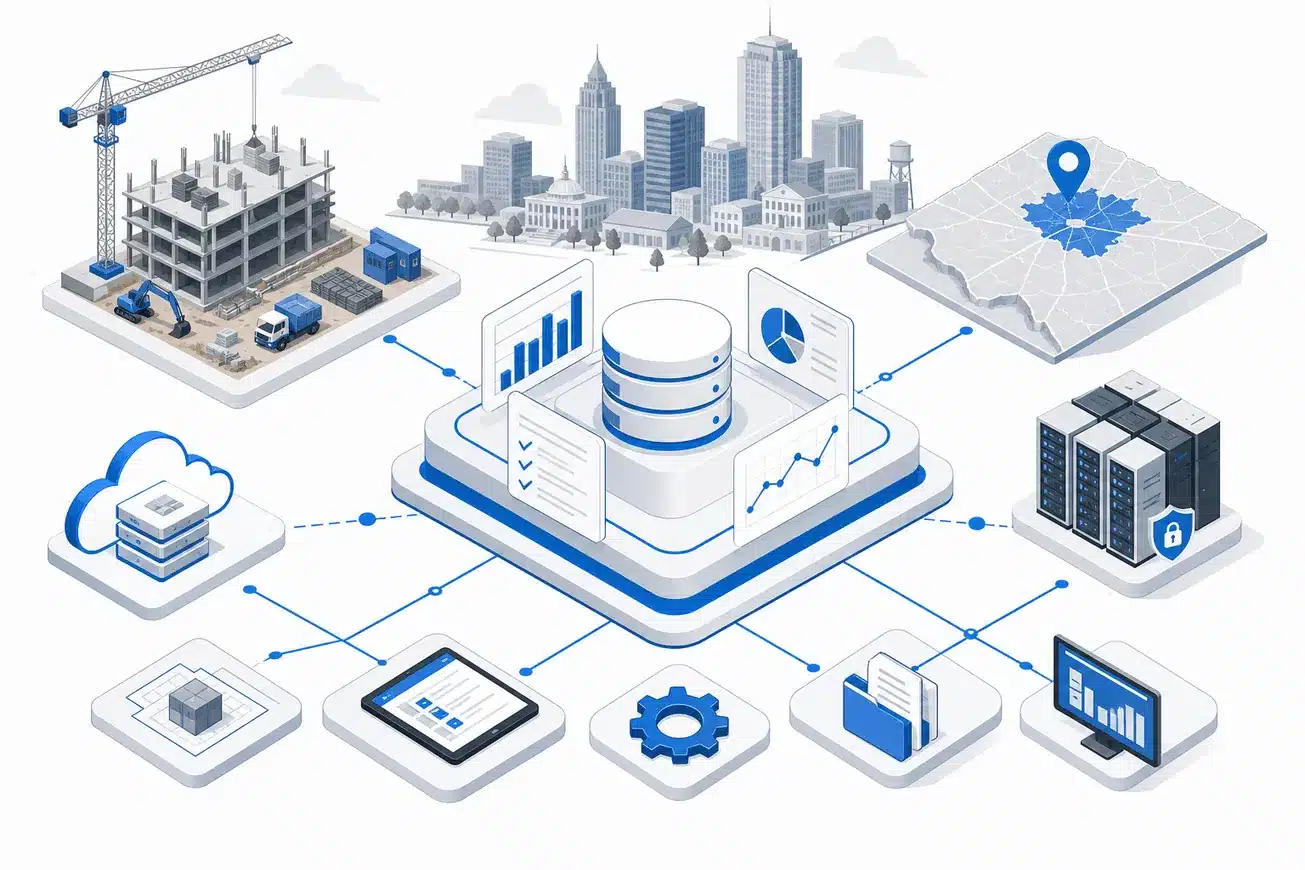
Construction Technology and Risk by the Numbers
Sources: U.S. Census Bureau, Realtor.com, Construction Coverage / BLS, IoT Marketing 2025 review of BIM research, ServiceTitan 2026 Commercial Specialty Contractor Industry Report, ENR/Zurich 2025 cybersecurity analysis, Dodge Construction Network and Egnyte AEC cybersecurity survey.
Jobsite Wi-Fi and Connectivity: The Single Biggest Field Problem
Almost every Raleigh contractor has the same recurring complaint: connectivity at the jobsite is unreliable, and downtime hits everyone from the superintendent to the framing crew. Most temporary sites depend on a single 4G or 5G hotspot, with no failover and no signal survey to begin with.
A real jobsite network is engineered, not improvised. That means a roof-mounted cellular antenna on the trailer, a dual-SIM router with carrier failover across Verizon, AT&T, and T-Mobile, and a hardened access point that can throw Wi-Fi 150 feet across an active foundation pour.
Site selection matters too. Trailer position, line of sight to towers off I-540 or US-1, and even tree cover during summer leaf-on conditions can change actual throughput by 30 to 50 percent.
A construction IT partner runs that survey before you mobilize. The cost of a 20 minute site visit during preconstruction is a tiny fraction of the cost of a week of crews waiting on a stuck inspection upload.
Rugged Mobile Devices and Field Hardware That Survive the Site
Consumer phones and off-the-shelf tablets do not survive long on a Raleigh jobsite. Dust, summer heat in a sealed truck cab, dropped devices on concrete, and the occasional thunderstorm at an exposed pour all take their toll.
The fix is the right device, not just a tougher case. Models like the Samsung XCover, Zebra TC series, Panasonic Toughbook, and ruggedized iPad enclosures rated to IP65 are built for this duty, and they pair with mobile device management to keep apps current and data wiped if a device disappears.
Bring-your-own-device might feel cheap, but it is the most common source of after-hours support calls. A foreman logging into Procore from a personal phone has no central control, no remote wipe, and no consistent backup.
Standardized hardware with MDM cuts that noise. It also lets you swap a broken unit in under an hour instead of losing a half day of progress photos.

Project Management Software and Field-to-Office Integration
Procore, Autodesk Build, PlanGrid, Buildertrend, and Sage are the names you hear most often in Raleigh trailers. The hard part is not picking one, it is making them talk to each other and to QuickBooks Enterprise or Sage 300 CRE in the office.
Most data loss in construction happens at the seams between systems. A change order entered on a tablet in the field that never makes it to accounting will eat margin on the next pay application.
A construction IT partner sets up those integrations, then monitors them. That includes user provisioning when a PM joins or leaves, single sign-on across the suite, and shared folder structures that match how your project teams actually file documents.
The payoff is real and measurable. A recent study in Discover Materials found that BIM implementation cuts design errors by 30 percent and project timelines by 20 percent on average, and a similar effect shows up when field and office data finally share one source of truth.
Fleet Tracking, Compliance, and Documentation
Federal ELD rules, state DOT requirements, and OSHA recordkeeping all touch your IT stack now. GPS trackers on pickups and equipment feed Samsara, Verizon Connect, or Geotab, and that data lives next to your project records.
Insurance audits and EMR reviews lean on this data every year. Lost video from a backup camera or a missing pre-trip inspection log can shift premiums in the wrong direction at renewal.
Compliance documentation is also where construction firms get tripped up on payment. Federally funded Raleigh and Wake County projects require certified payroll, Davis-Bacon documentation, and a paper trail that a manual filing cabinet cannot keep up with.
An IT partner with construction experience builds the document retention and backup policy around those obligations. The same setup also speeds up bid responses when an owner asks for prior project records on short notice.
Cybersecurity Risks Construction Companies Cannot Ignore
Construction has become one of the most attacked industries by ransomware operators. In September of 2025, a resurgence in ransomware activity resulted in 562 public attacks reported, with construction and engineering as the most impacted sector, making up 11.4% of victims
.
The reasons are structural. Tight deadlines, heavy use of third-party subcontractors, mobile devices on unmanaged networks, and historically thin IT budgets make construction firms an easier mark than a comparable bank or hospital.
Among surveyed AEC firms, 59% say that they have experienced a cybersecurity threat in the last two years, and GCs were the hardest hit at 70%, with 30% having had a ransomware attack since 2021. Most of those incidents started with a phishing email, often impersonating an owner, architect, or vendor with a fake change order or pay application.
Defense is layered and not expensive when planned right. Multi-factor authentication, managed endpoint detection, phishing training, segmented Wi-Fi for guests and subs, and tested backups are the baseline a Raleigh contractor should expect from an IT partner.
What to Look For in a Raleigh Construction IT Partner
Not every Triangle MSP is a fit for construction. The simple test is whether they have ever stood up a temporary network in a job trailer off Glenwood Avenue or troubleshot a Procore sync on a Zebra tablet at 6 in the morning.
Specific questions to ask include whether they stock LTE failover routers, whether they support Procore and Autodesk Build directly, and whether they offer same-day field response in Wake, Durham, and Johnston counties. Vague answers are the signal.
References from other Raleigh contractors are worth more than a glossy website. Ask for the names of two or three GCs or specialty trades that use the firm for jobsite IT, not just office IT.
A good partner also writes things down. Get a short statement of work, a documented escalation path, and a fixed monthly price that includes both office and field support, so you are not haggling on the day a fiber cut takes the trailer offline.
Frequently Asked Questions
How much does construction IT support in Raleigh typically cost?
Monthly managed IT for a mid-size Raleigh contractor usually falls between 100 and 200 dollars per user per month, depending on whether jobsite networks, mobile device management, and cybersecurity tools are bundled in. Project-based work like setting up a new job trailer network or migrating to Procore is quoted separately, with most trailer network setups landing in the 1,500 to 4,000 dollar range including equipment.
Can you support Procore, Autodesk Build, and Sage 300 CRE?
Yes, RCOR supports the major construction platforms used in the Triangle, including Procore, Autodesk Build, PlanGrid, Buildertrend, and accounting tools like Sage 300 CRE and QuickBooks Enterprise. We handle user provisioning, integration support, license management, and day-to-day help desk for these systems.
Do you handle jobsite Wi-Fi setup, or only office IT?
Both. We design and deploy temporary jobsite networks across Raleigh, Durham, Cary, Apex, and Wake Forest, including cellular failover, trailer-mounted antennas, and ruggedized access points for active build areas, then break them down and redeploy when the project closes out.
How fast can you get a technician on a Raleigh jobsite?
For managed clients in Wake County, our standard onsite response for jobsite emergencies is same business day when the call comes in before 1 in the afternoon, and four hours for contracted priority issues. We route Triangle-based engineers, so there is no waiting on a technician driving in from out of state.
What cybersecurity protections should a Raleigh contractor have in place right now?
At minimum, every contractor should have multi-factor authentication on email and Procore, managed endpoint detection and response on every laptop, phishing simulation training, segmented Wi-Fi for guests and subcontractors, and tested offsite backups. Cyber insurance carriers increasingly require these controls before they will write or renew a policy at a workable rate.

About the author
Tim Richter - Co-Founder / President
Tim Richter is Co-Founder and President of RCOR, a managed IT and cybersecurity firm that has been serving businesses across Raleigh and Durham since 1992. He brings more than 35 years in the IT industry and today leads a team providing enterprise-class network support to small and mid-sized organizations throughout the Research Triangle.