
The Research Triangle has become one of the most attractive targets for cybercriminals in the Southeast, and 2026 is shaping up to be the busiest year on record for incidents touching Raleigh, Durham, and Cary employers. Tech firms, healthcare systems, universities, and government contractors all share the same network of suppliers, which is the kind of dense, high value cluster that ransomware crews and phishing operators love to hit.
This briefing walks through the specific threats local owners and IT leaders should plan for in 2026, the costs that show up after a breach, and the controls that move risk the most. Numbers come from IBM, Sophos, Verizon, Check Point, and the FBI Internet Crime Complaint Center, then translate into what they mean for a 25 to 250 person Triangle business.
Key Takeaways
- Phishing was the leading initial attack vector in IBM’s 2025 study at roughly 16 percent of breaches, and the great majority of phishing emails now use AI to write more convincing lures.
- The US average data breach cost climbed to about $10 million in 2025, while healthcare, a major Triangle employer, still averaged more than $7 million per breach.
- Q1 2025 set a new ransomware record with a 126 percent year over year jump in disclosed victims, and most attacks land on small and mid sized businesses rather than enterprises.
- MFA, tested backups, security awareness training, and a managed detection partner remain the four controls with the highest return on risk reduction for Raleigh businesses.
Why Raleigh-Durham Is a High Value Target in 2026
Raleigh sits at the intersection of several industries that make it a prime target for cyberattacks. The region hosts hundreds of technology companies, a massive healthcare sector handling millions of patient records, defense contractors supporting military operations, financial institutions managing billions in assets, and government agencies at the state and local level.
Every one of those sectors holds data that cybercriminals consider extremely valuable. Threat actors specifically target small and mid sized businesses that often lack the security infrastructure of larger enterprises, and vendor relationships create paths into bigger names.
Across Raleigh, Durham, and Cary, small and mid sized businesses are increasingly choosing to pay ransoms because operational pressure leaves no easy recovery path once an incident lands. Even with backups, restoring a 25 to 50 person environment can take days, and that downtime is what drives most of the real cost.
Cybercriminals know this market well. Fort Liberty contractors, RTP based tech firms, biotech startups in Durham, and the dozens of Wake County medical practices that share systems with the major health networks all show up on the same target lists, and the local impact compounds because so many vendors serve overlapping clients.
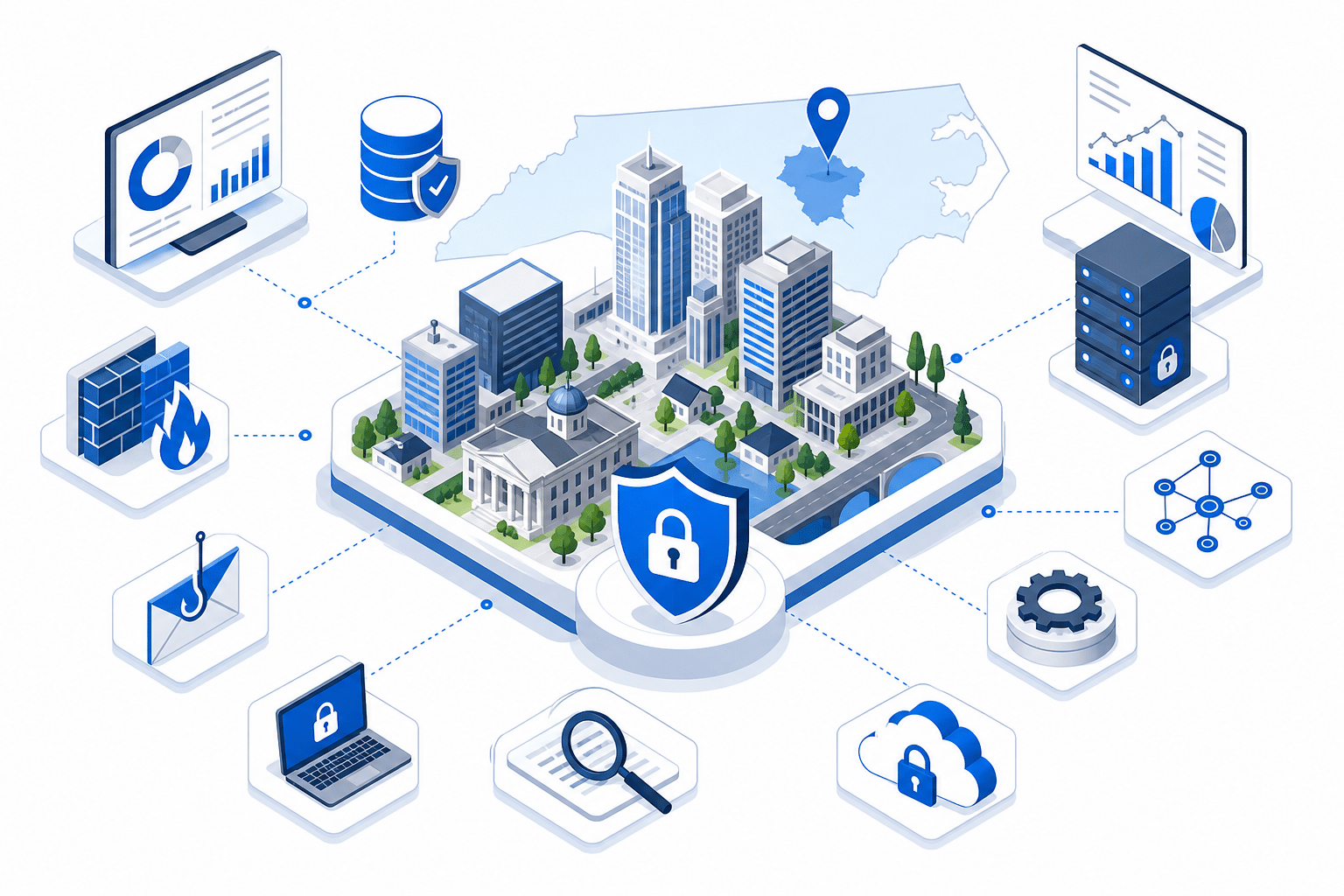
Raleigh-Durham Cyber Threat Snapshot: 2025 to 2026
Sources: IBM Cost of a Data Breach Report 2025, Sophos State of Ransomware 2025, Check Point Research Q1 2025, Verizon 2025 DBIR, FBI IC3 2024-2025 reports, KnowBe4 2025 Phishing Trends.
Ransomware: From Encryption to Double Extortion
Q1 2025 marked a turning point in ransomware activity that has carried straight into 2026. Check Point Research reported a 126 percent year over year increase in publicly disclosed ransomware victims, rising from 1,011 in Q1 2024 to 2,289 in Q1 2025, the steepest single quarter rise on record.
The economics are brutal for a Triangle business. The 2025 average ransomware attack cost is estimated between $5 million and $6 million once ransom, recovery, downtime, and reputational damage are stacked together, with average downtime sitting at roughly 24 days from initial detection to full restoration.
Modern crews steal data first and encrypt second, which is called double extortion. A Raleigh manufacturer hit on a Friday afternoon can find sensitive blueprints offered to competitors by Monday morning, even if backups restore cleanly and the ransom is refused.
Preparation does work, and the data proves it. In 2025, 63 percent of organizations refused to pay the ransom, up from 59 percent in 2024, largely because backup reliability and tested incident response plans gave them a real recovery path.
AI Generated Phishing Is the New Normal
Phishing was the leading initial access vector in 2025, accounting for almost 16 percent of data breaches, replacing stolen credentials as the top entry point. Phishing related breaches average nearly $5 million per incident, and the numbers matter more in 2026 because the messages no longer look like phishing.
Nearly 83 percent of phishing emails are AI generated, according to KnowBe4’s 2025 Phishing Trends Threat Report, and independent analyses put the figure at over 80 percent. Perfect grammar, accurate company context, and convincing executive impersonation are now the default rather than the exception.
Business email compromise sits underneath this trend and hits Triangle finance teams particularly hard. The FBI IC3 reported BEC fraud cost US complainants more than $3 billion across 12 months, and a 37 percent rise in AI assisted BEC incidents was recorded in the FBI’s 2025 IC3 report.
Real estate closers, law firms handling escrow, and accounting teams approving wire transfers are the highest risk roles in a typical Raleigh office. A single approved transfer to a spoofed vendor account can wipe out a year of operating margin and trigger client lawsuits that drag on long after the money is gone.

Supply Chain and Third Party Risk Across the Triangle
Supply chain compromise rose to the number two initial access vector in IBM’s 2025 report at roughly 15 percent of breaches. The pattern is painfully familiar in North Carolina, where one vendor compromise often touches dozens of in state employers at once.
In 2023, a hidden cyberattack quietly exposed sensitive data from patients across North Carolina’s largest hospital systems, including UNC Health, Duke, Atrium, and ECU, through a software provider they relied on, Nuance Communications, which used a file transfer tool called MOVEit that was compromised in a global ransomware campaign. None of those health systems were hacked directly, yet all of them ended up notifying patients about exposed records.
For most Raleigh businesses, third party risk now drives more breach exposure than the network perimeter does. Every SaaS app with a token in your Microsoft 365 tenant is a path to your data, and every vendor with file transfer access is a path to your network.
Practical vendor risk management for a Triangle SMB means short, repeatable security questionnaires, contractual notification requirements, and a documented offboarding process when a vendor relationship ends. None of that work is glamorous, but it cuts the most common third party blast radius dramatically.
Industry Specific Threats Across the Triangle
Healthcare remains the costliest sector for the 14th year, with breaches averaging more than $7 million per incident in 2025. With Duke Health, UNC Health, WakeMed, and a dense network of private practices, this is a load bearing risk for the region.
Technology firms and biotech companies face a different mix. Source code theft, AI model exposure, and intellectual property loss show up more often than ransomware, and breaches involving shadow AI cost organizations $4.63 million on average, $670,000 more than standard incidents
.
Manufacturing became the most targeted sector in 2025 with a 61 percent jump in attacks as cybercriminals exploit industrial control systems with inadequate security patches. The IT to OT convergence trend means even small manufacturers or logistics providers could see production grind to a halt from a ransomware incident.
Financial services average $5.56 million per breach, with regulatory exposure stacked on top of recovery costs . Education and government, including local agencies and Wake County school systems, have also seen repeated ransomware events through 2025
.
Cyber Insurance and Compliance Pressure on Triangle Businesses
Cyber insurance underwriting tightened sharply through 2024 and 2025. Carriers now require documented MFA, EDR, immutable backups, and a recent risk assessment before they will quote a Raleigh business, and rates rise steeply for any control gap a carrier finds in the application.
Compliance pressure is also rising for the region. Healthcare practices face HIPAA enforcement, defense contractors face CMMC requirements, retailers and restaurants face PCI DSS, and IBM found 32 percent of breached organizations paid regulatory fines, with 48 percent exceeding $100,000.
Most policies will not pay if a breach traces back to a missing control listed in the application. A business that claimed MFA on every account but only had it on email will discover the gap in the worst possible moment, after the wire has already left the bank.
Working with a managed security partner gives Triangle owners a third party paper trail that satisfies underwriters and regulators alike. That paper trail matters as much as the controls themselves when an auditor or carrier shows up after an incident.
Practical Defenses That Cut Risk the Most
Multi factor authentication is still the single highest return control available to a Raleigh SMB. Organizations implementing multi-factor authentication reduced credential based attacks by 82 percent, achieving the highest ROI from a security investment of under $10K annually.
Tested backups are the second pillar of any serious program. Organizations that tested their backup systems quarterly recovered 3x faster than those that never validated their restoration processes, and organizations that maintained offline backups reduced recovery costs by 44 percent compared to those paying ransom demands.
Continuous security awareness training matters because human elements in cyber attacks have plateaued at around 60 percent of cases per Verizon’s 2025 DBIR. Behavior based phishing programs achieve failure rates around 1.5 percent, while annual training shows negligible improvement over untrained populations
.
AI and automation on the defender side now pays for itself. Organizations using AI tools extensively cut their breach lifecycle by 80 days and saved nearly $1.9 million on average, which is why managed detection and response is no longer a luxury for mid sized Triangle firms
.
How RCOR Approaches Managed Cybersecurity in Raleigh
RCOR builds layered defenses for Triangle businesses around four pillars: identity, endpoint, network, and human. Each pillar maps to specific controls with documented effectiveness, not a generic checklist.
Identity work starts with MFA everywhere, conditional access on Microsoft 365 or Google Workspace, privileged access controls for IT and finance, and modern phishing resistant authentication for the highest risk roles. Endpoint work pairs EDR with patch management on a known cadence, application allowlisting where it fits, and removable media controls.
Network work is segmentation, DNS filtering, and continuous monitoring tied to an incident response retainer, so detection becomes a 24/7 service rather than a Monday morning surprise. Human work is monthly phishing simulations, role based training for finance and IT, and tabletop exercises at least once a year.
Comprehensive cybersecurity services for small and mid sized businesses in the Raleigh market typically range from $2,000 to $10,000 per month depending on the size and complexity of the environment. That is a fraction of what a single ransomware incident actually costs once downtime and recovery are included, before reputation damage even enters the math.
Frequently Asked Questions
What are the top cyber threats facing Raleigh-Durham businesses in 2026?
The four threats that show up most often for Raleigh and Durham businesses in 2026 are AI generated phishing, ransomware with double extortion, supply chain compromise through a SaaS vendor or file transfer tool, and business email compromise targeting finance teams. Healthcare practices and manufacturers face an extra layer of risk because their downtime translates directly into patient impact or production loss.
Most successful intrusions still begin with a person clicking a link, so identity controls and ongoing training carry the most weight in a small environment.
How much does a cyberattack typically cost a small or mid sized Triangle business?
The US average breach cost hit $10.22 million in 2025 according to IBM, but the more useful number for a 25 to 250 person Triangle SMB is the average total breach cost for SMBs of $254,445 according to Astra Security . That figure includes ransom if paid, recovery labor, hardware replacement, legal and notification costs, and lost revenue during downtime
. Business closure rate after breach runs 60 percent within six months per StrongDM, which is the real risk most owners underestimate .
Is my Raleigh business too small to be a real target?
No, and that assumption is one of the most consistent predictors of a successful attack. Chainalysis data shows initial access to small business networks sells for as little as $439, and with automated scanning tools, ransomware attacks are increasingly opportunistic.
Attackers often prefer SMBs because defenses are weaker, decision making is faster, and the willingness to pay is higher when operations stop.
How quickly can a ransomware attack take down a Raleigh business?
Modern ransomware can encrypt an entire small business network in minutes to hours, depending on the variant and network size. Ransomware attacks frequently begin on Friday evenings or holiday weekends so detection lags by the time the on call team responds.
For a 25 to 50 person North Carolina manufacturer, expect 3 to 7 days of significant disruption with good backups, or 2 to 4 weeks without.
What does managed cybersecurity in Raleigh actually include?
A solid managed cybersecurity program for a Raleigh SMB covers identity (MFA, conditional access, privileged access management), endpoint detection and response with patch management, network monitoring with 24/7 SOC eyes, email security with phishing simulation, and a tested incident response plan with an annual tabletop exercise. Backups should be immutable, tested quarterly, and stored offline or in a separate cloud tenant.
For a 50 person NC business, comprehensive managed security might cost $3,750 to $8,750 per month depending on compliance requirements and the size of the environment.
What is the first thing we should do if we suspect we are under attack?
Isolate first and investigate second. Disconnect affected machines from the network, preserve logs, and call your managed security partner or incident response retainer before powering anything down, because shutdown can destroy forensic evidence.
Then notify your cyber insurance carrier within the policy window, because late notification is a common reason claims get denied.