
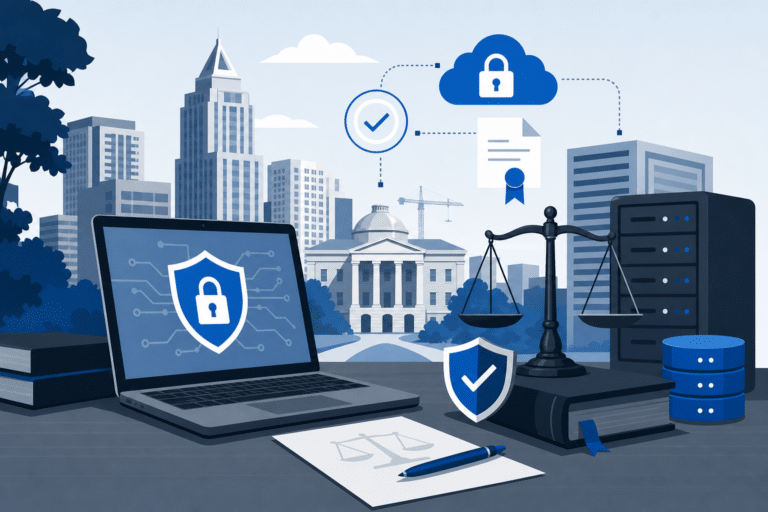
Raleigh law firms sit on a goldmine of sensitive information, from M&A drafts and patent filings to sealed criminal records and trust account ledgers. That data is exactly why ransomware crews, business email compromise gangs, and credential thieves have made the legal sector one of their favorite targets in 2024 and 2025.
RCOR works with firms across Raleigh, Durham, Cary, and the rest of the Triangle, and we have watched the operational and ethical pressure on partners ratchet up year after year. This guide covers what specialized law firm IT services in Raleigh actually look like, what the threat numbers say, and how to stay aligned with the ABA Model Rules without grinding billable hours to a halt.
Key Takeaways
- The average cost of a data breach for a law firm reached $5.08 million in 2024, a roughly 10% jump year over year per Clio and IBM reporting.
- ABA Model Rules 1.1 and 1.6 require attorneys to maintain technological competence and make reasonable efforts to safeguard client information, including digital data.
- Only 34% of law firms have a documented incident response plan, down from 42% the year before, leaving most firms exposed to the aftermath of an attack.
- Specialized legal IT covers four pillars: cybersecurity, regulatory compliance, document and matter management, and e-discovery readiness.
Why Raleigh Law Firms Are a Prime Cyber Target
Raleigh has been one of the most impressive US markets for law firm growth, ranked the ninth fastest growth market in a CBRE North American Legal Sector Trends study. That growth pairs with a Triangle economy heavy on biotech, life sciences, and emerging technology, which means local firms routinely handle IP, regulatory, and corporate work that attackers prize.
Attackers also know that law firms are a soft middle of the supply chain: rich in privileged data, lighter on in-house security staff than the banks or hospitals they serve. The 2024 ABA Cybersecurity Tech Report found that 36% of firms reported a security incident in the past year.
Even more telling, nearly 1 in 5 law firms are not certain whether they have been breached at all, according to the ABA’s cybersecurity reporting. That uncertainty alone is a compliance and disclosure problem under ABA Formal Opinion 483, which expects timely investigation and client notification when unauthorized access is suspected.
The pattern is not improving in the Triangle or anywhere else. Baker and Hostetler, whose digital assets practice guided clients through more than 1,250 cyber incidents in 2025, reported responding to over 30 law firm incidents in 2024 and said that number nearly doubled in 2025.
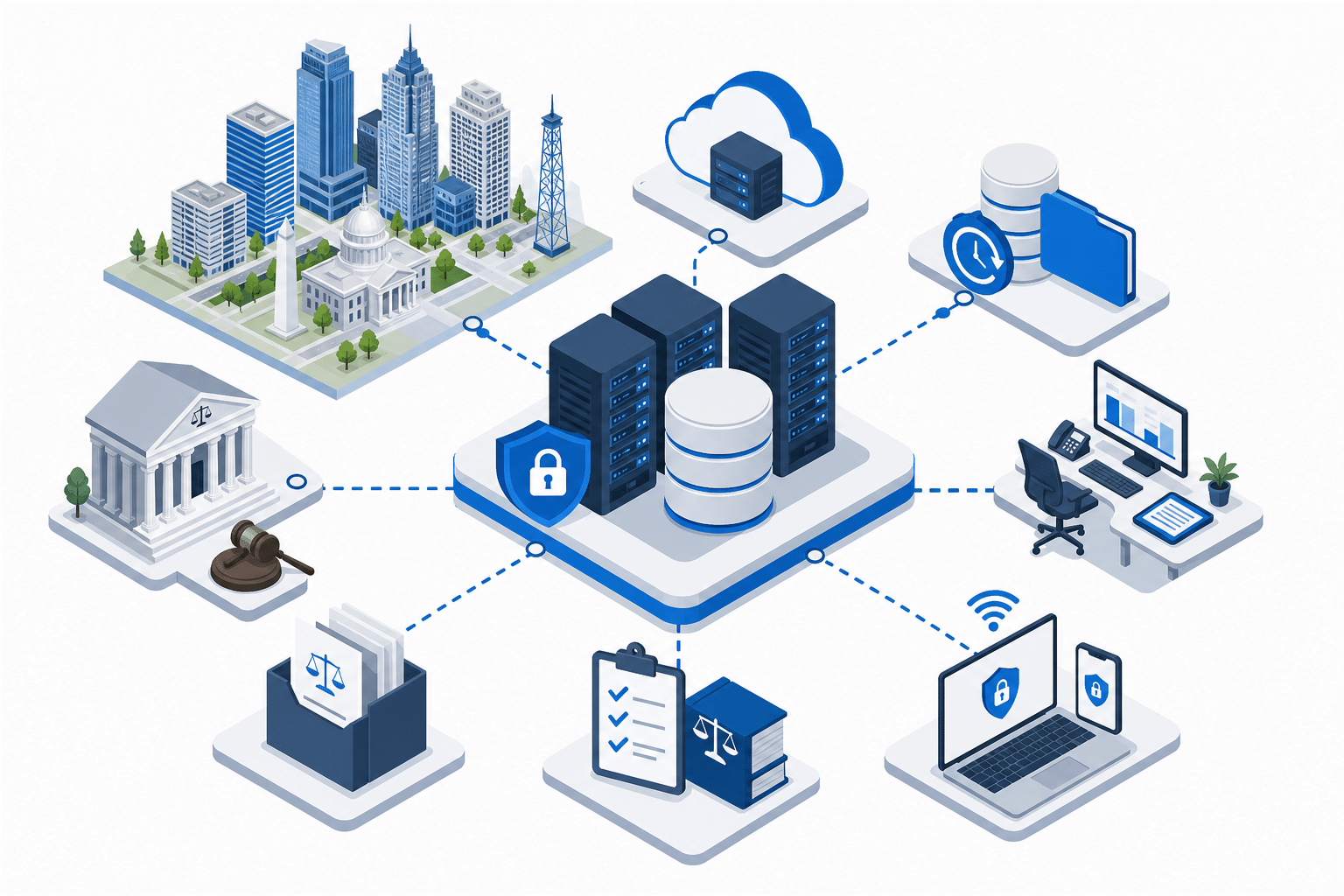
Law Firm Cyber Threat and Breach Cost Snapshot
Sources: IBM Cost of a Data Breach Report 2024, Clio 2024 breach data, ABA 2024 Cybersecurity TechReport, 2025 Verizon DBIR.
The Ethical Bar: ABA Model Rules and North Carolina Duties
Cybersecurity is no longer just an IT decision for Raleigh lawyers, it is an ethics decision with disciplinary teeth. ABA Model Rule 1.6(c) requires attorneys to make reasonable efforts to prevent the inadvertent or unauthorized disclosure of, or unauthorized access to, information relating to the representation of a client, and that obligation clearly extends to digital files, email, cloud storage, and metadata
Comment 8 to Model Rule 1.1 goes further on the competence side, telling lawyers to keep abreast of the benefits and risks associated with relevant technology . North Carolina has adopted parallel duties, so a Wake County partner cannot quietly outsource awareness of phishing, encryption, or vendor due diligence to the office manager
ABA Formal Opinion 477R adds specifics for client communications, asking attorneys to weigh sensitivity, likelihood of disclosure, cost of safeguards, and the impact on representation. The result is a fact specific standard that does not give you a single checklist, but it does demand a defensible process you can show a regulator or insurer.
Failing that standard is not theoretical. ABA Formal Opinion 483 directs firms to detect breaches, notify affected clients, and document remediation, and recent class actions against firms such as Bryan Cave and Cadwalader show that plaintiffs are willing to argue that inadequate cybersecurity is itself negligence.
What a Breach Actually Costs a Triangle Firm
The headline number from Clio puts the 2024 average data breach cost for a law firm at $5.08 million, more than 10% higher than the year before . IBM’s 2024 Cost of a Data Breach Report shows the global cross industry average at $4.88 million and the US average at $9.36 milli
on.
Behind those averages sit very tangible line items. Breaches involving stolen or compromised credentials take an average of 292 days to identify and contain, the longest of any attack vector, while the average cost per compromised record now sits around $150.
For a 40 attorney firm in North Hills or Brier Creek, the worst part of a serious incident is rarely the ransom payment itself. It is the cascade that follows: lost billable hours during forensic recovery, regulatory and bar notification work, mandatory credit monitoring for affected clients, and the slow attrition of corporate clients who quietly take their next matter somewhere else.
Insurance helps, but it is not unconditional. Only 40% of law firms now carry cyber liability coverage, down from 46% in prior years, and carriers increasingly deny claims when a firm cannot demonstrate basic controls such as MFA, EDR, and tested backups.

The Threat Landscape: How Attackers Actually Get In
The threats hitting Raleigh legal practices line up with the broader industry picture. Phishing and other human element attacks drive roughly 60% of breaches according to the 2025 Verizon DBIR, and law firms remain disproportionately targeted because of the value of the data they hold.
Business email compromise is the most direct revenue threat. A spoofed wire instruction during a real estate closing or a settlement disbursement can move six figures out the door before anyone notices, and the FBI’s IC3 tied BEC to more than $2.9 billion in reported losses in 2023 alone
Ransomware is the second face of the same problem. Attackers encrypt case files, demand payment in cryptocurrency, and increasingly steal data first so they can extort the firm a second time even after files are restored from backup, a tactic that has turned ‘we have good backups’ into a partial defense at best.
Insider and credential risk round out the short list. Misconfigured permissions, departing associates who keep broad access, contractors using personal devices, and partners who reuse passwords across firm and personal accounts all create exposure that no firewall alone can close.
Core Components of Law Firm IT Services in Raleigh
Specialized legal IT support in Raleigh and Durham starts with a layered security stack: managed endpoint detection and response on every device, identity and access management with MFA on every account, email gateway filtering with anti phishing and impersonation controls, encrypted laptop drives, and 24/7 SOC monitoring. These controls map directly to the reasonable efforts standard that the ABA Model Rules and the North Carolina State Bar expect.
Next comes data governance built specifically for legal work. That means encrypted email and secure file sharing for outside counsel and clients, granular permission controls on matter folders, ethical walls between conflicting matters, audit logs that can survive a discovery request, and retention rules that match state and federal preservation duties.
Practice management integration is the third pillar. A lawyer IT services provider in Raleigh NC should support Clio, NetDocuments, iManage, ProLaw, Worldox, Tabs3, and the core Microsoft 365 stack without forcing the firm onto a generic SMB template, and it should understand how time, billing, conflict, and document systems talk to each other.
Finally, business continuity ties it all together. Tested, immutable, offline backups, a documented disaster recovery runbook, and a written incident response plan are the difference between a 4 hour outage and a 2 week shutdown that triggers missed court deadlines, malpractice exposure, and bar complaints.
E-Discovery, Document Management, and Matter Centric Workflows
Litigators in the Triangle deal with e-discovery on schedules that do not flex. A firm that cannot collect, process, and produce ESI on time risks Rule 37 sanctions, credibility with the bench, and follow on disputes about spoliation that can swallow whole weeks of partner attention.
Solid law firm technology in Raleigh treats matter management as the backbone, not an afterthought. Every email, document, time entry, and chat thread should attach to a matter, version itself automatically, and retain under a policy that matches state and federal preservation rules.
Cloud document management platforms like NetDocuments, iManage, and Worldox handle most of the heavy lifting out of the box, but they still need configuration that matches your firm’s practice mix and ethical walls. A generic SharePoint deployment configured by a generalist IT shop is not the same thing, and treating it that way invites privilege waivers, accidental client to client disclosures, and discovery disputes.
When litigation hits, a properly configured environment turns a legal hold into a few clicks instead of a paralegal chasing custodians by email and Slack. That is the operational efficiency side of the same coin that protects you on the compliance side, and it is the kind of capability that pays for itself the first time a major matter lands on the firm.
Firms that want a broader view of how technology strategy supports long-term practice development should explore our overview of Managed IT Services For Legal, which maps the same security and efficiency principles to growth planning across the firm lifecycle.
How to Choose Legal IT Support in Raleigh and Durham
Start with experience in the legal vertical, not just IT credentials. Generalist MSPs can keep printers running and patch servers, but few understand the difference between a litigation hold, an ethical wall, a conflict check workflow, and a privileged communications protocol.
Ask any prospective provider for specifics: how many law firm clients do they support, which practice management platforms have they migrated, and can they produce a SOC 2 Type II report for their own operations. If they hesitate on any of those questions, keep looking.
Geography also matters in a market like Raleigh and Durham. Same day onsite support for a Glenwood South office, an RTP suite, or a Cary practice should not be a stretch, and it is the difference between a 2 hour interruption and a full day of lost billables across a dozen attorneys.
Finally, evaluate the partnership model rather than just the monthly quote. A good legal IT provider runs quarterly business reviews, maps controls to ABA guidance and your cyber insurance application, tracks user training completion, and gives partners a clear, plain English read on risk every quarter.
Frequently Asked Questions
Do small law firms in Raleigh really need the same IT security as large firms?
Yes, and in many cases the pressure is higher. Attackers actively target small and mid size firms because they hold the same sensitive client data as BigLaw but typically run thinner defenses, and ABA Model Rule 1.6 applies to every attorney regardless of firm size
. A solo practitioner in Cameron Village has the same duty to protect client confidentiality as a 150 lawyer firm downtown .
What does reasonable efforts under ABA Model Rule 1.6 actually mean in practice?
The ABA deliberately avoids a single checklist and instead uses a fact specific test that weighs the sensitivity of the information, the likelihood of disclosure, the cost and difficulty of safeguards, and how those safeguards affect your ability to represent the client. In practical terms today, that almost always includes multi factor authentication, encrypted options for sensitive email, current endpoint protection, documented staff training, vetted vendors, and a written incident response plan.
How quickly can a Raleigh law firm get back to work after a ransomware attack?
Recovery time depends almost entirely on backups and planning. Firms with tested, immutable, offline backups and a rehearsed incident response plan often resume core operations within 24 to 72 hours, while firms without those controls regularly report multi week disruptions and, in some cases, irreversible data loss.
Does cyber liability insurance cover a law firm breach automatically?
Not anymore. Carriers now require documented controls such as MFA, EDR, email filtering, and a tested incident response plan as a condition of coverage, and they will deny claims when those controls were promised on the application but were not in place at the time of the breach.
What is e-discovery readiness, and why does it sit with IT?
E-discovery readiness is the ability to locate, preserve, collect, and produce electronically stored information on a defensible timeline when litigation or an investigation hits. It sits with IT because the underlying capability lives in how your email, file storage, mobile devices, and chat systems are configured, retained, and logged long before any preservation letter arrives.
Can a Raleigh firm move to the cloud and still meet ABA confidentiality duties?
Yes, and many already have. ABA opinions allow cloud storage and software as a service as long as the firm performs reasonable due diligence on the vendor’s security and contractual commitments and configures the platform appropriately for legal work, including encryption, access controls, audit logging, and clear data ownership terms.

About the author
Tim Richter - Co-Founder / President
Tim Richter is Co-Founder and President of RCOR, a managed IT and cybersecurity firm that has been serving businesses across Raleigh and Durham since 1992. He brings more than 35 years in the IT industry and today leads a team providing enterprise-class network support to small and mid-sized organizations throughout the Research Triangle.