

Getting software installation right in Durham, NC means fewer disruptions, lower security risk, and faster adoption across your team. Whether you are rolling out a new line-of-business application or upgrading collaboration tools, the process matters as much as the product.
This guide covers what Durham businesses should verify before any install, how to protect endpoints and data, and what a well-run deployment checklist looks like. It is built for owners and operations managers who need clear steps without the jargon.
Key Takeaways
- North Carolina has no single generic business license; required licenses and permits vary by business activity, location, and applicable state or local requirements.
- NIST Cybersecurity Framework 2.0 has six Functions: Govern, Identify, Protect, Detect, Respond, and Recover.
- A cybersecurity risk assessment before installation helps small businesses identify vulnerabilities and improvements to strengthen security posture.
- Endpoint protection, disk encryption, and tested backup recovery are installation-adjacent safeguards that reduce go-live risk.
Why software installation planning prevents costly rework
Poorly planned software deployments often create more operational friction than expected. Requirements that seem obvious in a vendor demo frequently clash with existing workflows, integrations, or compliance obligations once the install begins.
Defining requirements, users, integrations, and implementation ownership before any download starts keeps the project scoped and accountable. This step is where most hidden costs live, and catching them early is far less disruptive than retrofitting after go-live.
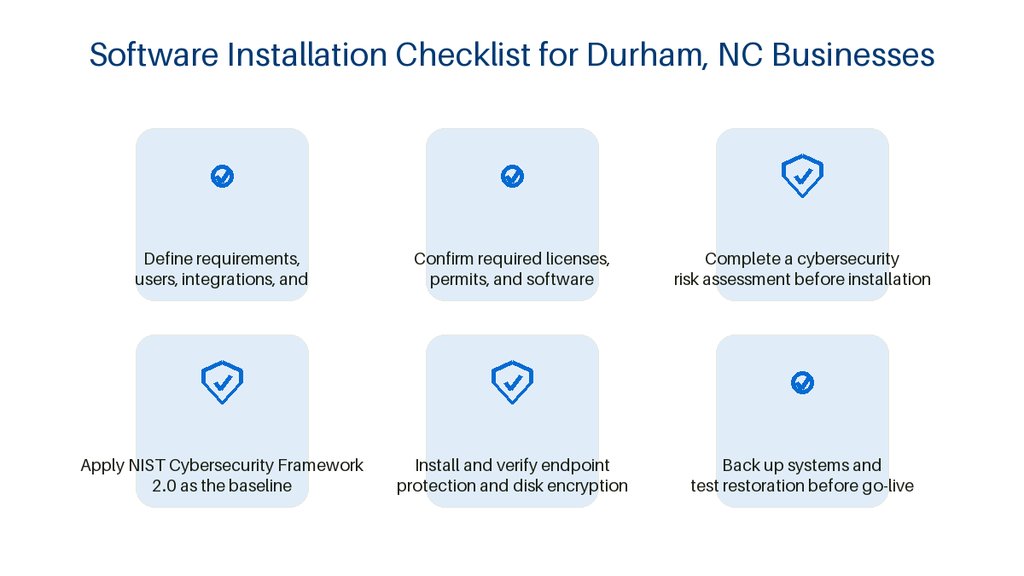
Software Installation Checklist for Durham, NC Businesses
- ✓Define requirements, users, integrations, and implementation ownership: Complete before vendor selection
- ✓Confirm required licenses, permits, and software entitlements: Varies by business activity, location, and applicable requirements
- ✓Complete a cybersecurity risk assessment before installation: Helps identify vulnerabilities and improvements
- ✓Apply NIST Cybersecurity Framework 2.0 as the baseline: Six Functions: Govern, Identify, Protect, Detect, Respond, Recover
- ✓Install and verify endpoint protection and disk encryption: Deploy across business workstations
- ✓Back up systems and test restoration before go-live: Confirm recovery capability
- ✓Monitor logs and maintain staffed support post-launch: Standard operational practice
- ✓Document rollback steps and incident response contacts: Keep accessible during launch window
Framework and licensing guidance sourced from North Carolina state resources and NIST publications.
What North Carolina businesses must verify before deployment
North Carolina has no single generic business license; required licenses and permits vary by business activity, location, and applicable state or local requirements North Carolina Business Start-Up Resources (2026). Software deployments are no exception: certain industries need entitlements, data-handling agreements, or local approvals before new tools enter production.
Reviewing these obligations before installation avoids compliance gaps that surface during audits or incident response. It also protects the business from using unlicensed software, which carries both legal exposure and security risk.
How risk assessments strengthen installation security
A cybersecurity risk assessment before installation helps small businesses identify vulnerabilities and improvements to strengthen security posture North Carolina Department of Information Technology (2026). This step is not just for large enterprises; it is a practical way to surface what the new software touches, who needs access, and where attackers might find a foothold.
The assessment should cover data classification, user privileges, network segmentation, and third-party dependencies. Results then feed directly into configuration decisions, so security is built in rather than bolted on after launch.
Applying the NIST Cybersecurity Framework to new software
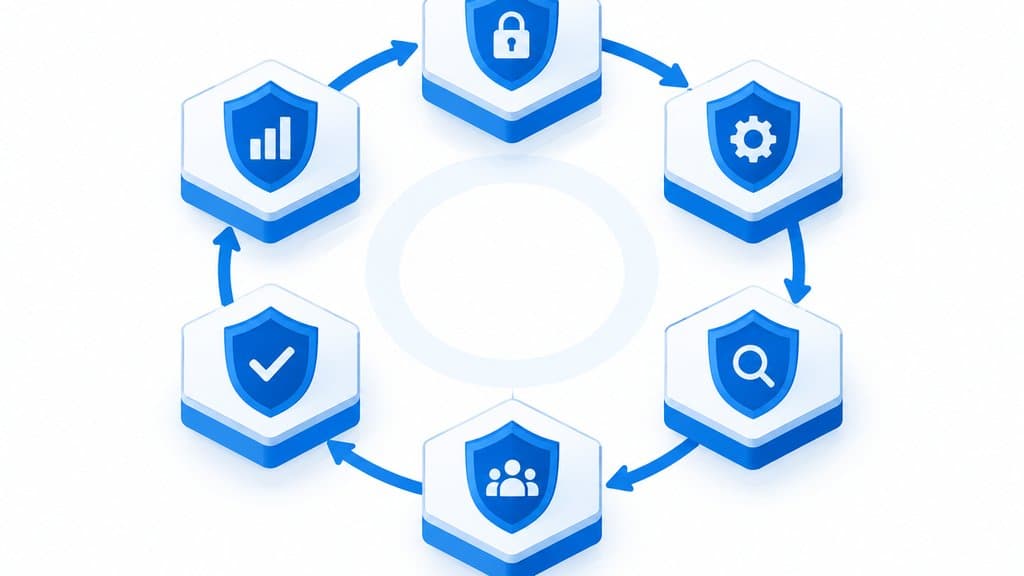
NIST Cybersecurity Framework 2.0 has six Functions: Govern, Identify, Protect, Detect, Respond, and Recover NIST Special Publication 1300 (2026). These functions provide a baseline for configuring, monitoring, and governing new software deployments without reinventing policy for every install.
Govern sets the strategic context. Identify maps assets and risks.
Protect builds access controls and encryption. Detect enables logging and anomaly spotting.
Respond and Recover prepare the team for incidents. Using this structure keeps each installation aligned with a recognized standard.
Endpoint protection and backup safeguards for go-live
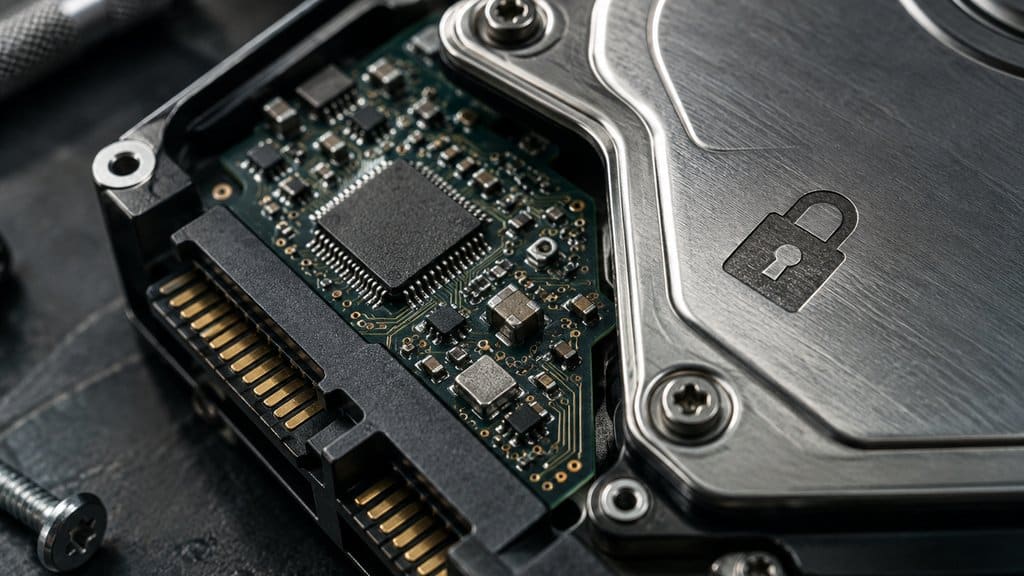
Endpoint protection and disk encryption reduce the attack surface on workstations that will run the new software. Antivirus, modern endpoint protection platforms, and encryption where appropriate are standard safeguards for compliance-oriented implementations in the Durham area.
Backup and recovery planning belongs in the same conversation. Automated backups, test restores, and documented recovery steps are installation-adjacent safeguards that protect against data loss during migration or configuration errors.
Testing restoration before go-live confirms the safeguard actually works.
How RCOR supports software installation for Durham businesses
RCOR has served Raleigh and Durham businesses since 1992 with enterprise-class network support scaled for small-company IT budgets. The team includes certified engineers who coordinate vendors, cut downtime, and deliver remote help-desk and on-site service across the Research Triangle.
RCOR offers two flat-rate plans: unlimited remote support with eight hours of on-site time per month, or a traditional all-inclusive option. The company also provides Microsoft 365 and Microsoft Teams deployment, configuration, and ongoing support for businesses standardizing on those platforms.
How network readiness determines installation success
Before any software reaches a Durham workstation, the underlying network must handle new traffic patterns. Bandwidth bottlenecks often surface only when applications begin syncing data across multiple locations.
RCOR evaluates switch capacity, wireless density, and VLAN segmentation prior to deployment. This prevents the performance degradation that frustrates users on day one.
Quality of Service policies deserve attention during preparation. Voice, video, and critical business applications need priority queuing to coexist without conflict.
Latency requirements vary dramatically between cloud-based tools and on-premise solutions. Understanding these thresholds allows RCOR to recommend infrastructure adjustments before installation begins.
Firewall rule updates frequently accompany new software rollouts. Opening ports without documentation creates security gaps that persist for years.
RCOR maintains detailed network change logs tied to each installation project. This practice simplifies troubleshooting and supports compliance audits down the road.
DNS configuration errors rank among the most common causes of failed cloud software launches. Verifying internal and external resolution paths early eliminates a major source of deployment delays.
Why user training timing affects adoption rates
Training delivered too early fades before employees touch the new system. RCOR schedules instruction close enough to go-live that skills remain fresh and applicable.
Hands-on practice with realistic data produces better retention than generic demonstrations. Durham businesses benefit from training environments populated with familiar customer records and workflows.
Role-based curriculum design prevents overwhelming staff with irrelevant features. Accounts payable personnel need different guidance than warehouse managers, even on the same platform.
Documentation quality matters as much as live instruction. RCOR helps clients build searchable quick-reference guides that reduce help desk volume after installation completes.
Change champions identified during planning become peer trainers. These internal advocates answer routine questions and sustain momentum when external consultants step back.
Feedback loops established in the first thirty days reveal training gaps. RCOR structures post-installation check-ins to capture user struggles and adjust support resources accordingly.
Resistance often stems from unclear business justification rather than technical difficulty. Connecting training content to specific operational improvements builds genuine user investment.

How licensing compliance protects Durham businesses long-term
Software audits arrive without warning and expose costly gaps in license management. Proactive tracking during installation prevents the penalties and reputational damage that follow noncompliance.
Volume licensing agreements offer flexibility but introduce complexity. RCOR helps Durham clients understand true-up requirements, downgrade rights, and reallocation provisions before committing.
Subscription models demand different oversight than perpetual licenses. Usage monitoring prevents both overpayment for unused seats and risky shortfalls during growth periods.
Virtualization and remote access create licensing scenarios that confound simple seat counting. RCOR documents how each product counts access under hybrid work arrangements common in North Carolina.
Open source components embedded in commercial solutions carry their own obligations. Understanding attribution requirements and copyleft provisions protects against unexpected legal exposure.
License migration during upgrades presents both opportunity and risk. RCOR verifies that existing entitlements transfer correctly and identifies any grandfathered terms worth preserving.
Centralized license repositories maintained after installation support renewal negotiations. Historical usage data strengthens a Durham business’s position when contract terms come up for discussion.
What post-installation validation confirms system integrity
Go-live marks a beginning rather than an endpoint for professional software installation. Structured validation procedures confirm that the system performs as specified before RCOR considers the project complete.
Functional testing verifies core workflows from end to end. Order entry, inventory updates, and financial reporting must execute correctly under production loads, not just in isolated demonstrations.
Integration points with existing systems require particular scrutiny. Data flowing between platforms must maintain format consistency and trigger appropriate downstream actions without manual intervention.
Performance baselines established during validation enable future comparison. When response times degrade months later, RCOR references these benchmarks to distinguish gradual drift from sudden failure.
User acceptance testing with actual staff surfaces issues that technical checks miss. A button that functions perfectly may still sit in an illogical location that slows daily operations.
Rollback readiness deserves final confirmation even after successful deployment. RCOR ensures restoration procedures remain tested and accessible should critical defects emerge after extended use.
Documentation of as-built configurations closes the knowledge loop. Future upgrades, audits, and troubleshooting all depend on accurate records of what was actually installed and how settings were applied.
Frequently Asked Questions
Do I need a specific business license to install new software in Durham, NC?
North Carolina has no single generic business license; required licenses and permits vary by business activity, location, and applicable state or local requirements. Check your industry and local jurisdiction to confirm what applies to your deployment.
What security framework should guide our software installation?
NIST Cybersecurity Framework 2.0 has six Functions: Govern, Identify, Protect, Detect, Respond, and Recover. These provide a recognized baseline for configuring and monitoring new software.
Why run a risk assessment before installing new software?
A cybersecurity risk assessment helps small businesses identify vulnerabilities and improvements to strengthen cybersecurity. It surfaces access, integration, and data risks before they become production incidents.
What endpoint safeguards should be in place before go-live?
Install and verify antivirus, endpoint protection, and disk encryption where appropriate. Test backup restoration before launch to confirm recovery capability.
How quickly can RCOR respond if our installation hits a problem?
If that window is missed, that work is free.
How does RCOR handle software installations that must occur outside normal business hours?
RCOR schedules after-hours and weekend installations for Durham businesses when operational continuity demands it. Our team coordinates closely with your staff to define precise windows, establish emergency escalation paths, and verify that all validation steps complete before your next business day begins.
This approach minimizes disruption while maintaining the same rigorous testing standards we apply during standard hours.