
Malware infections can freeze operations, expose customer data, and trigger regulatory headaches for Durham, NC businesses faster than most owners expect. When ransomware encrypts your files or spyware siphons credentials, the difference between a quick recovery and a weeks-long ordeal often comes down to preparation and the right local support partner.
This article gives Durham business owners a practical checklist for virus and malware removal, explains how regional threat patterns affect Triangle companies, and shows what to look for in a response partner who knows the local landscape.
Key Takeaways
- Ransomware complaints to the FBI IC3 exceeded 3,600 in the most recent annual reporting period, making malware removal readiness a business-critical function.
- Durham-area managed service providers commonly bundle virus removal with broader cybersecurity and IT management, giving businesses layered protection rather than one-time fixes.
- City and county government structures in Durham both maintain dedicated cybersecurity leadership, signaling that cyber risk is treated as a formal operational priority locally.
- Regional IT providers serving Durham typically cover Raleigh, Chapel Hill, and the broader Research Triangle, which matters for businesses with multiple locations or remote workers.
How Malware Infections Typically Reach Durham Businesses
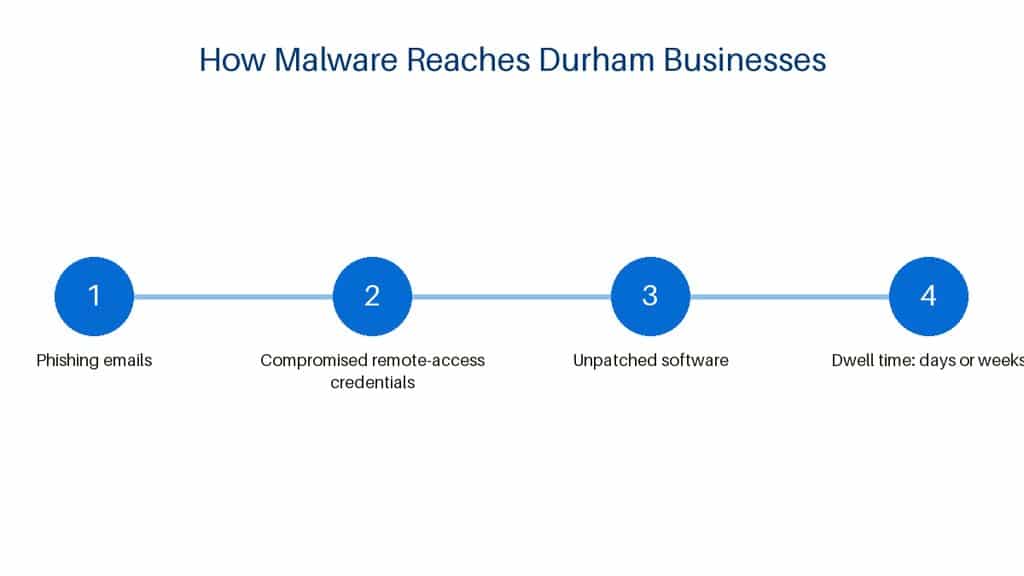
Most business malware infections in the Research Triangle arrive through phishing emails, compromised remote-access credentials, or unpatched software rather than sophisticated zero-day exploits. Attackers favor these vectors because they scale efficiently: one convincing email template can hit dozens of local businesses in a single campaign.
Once inside a network, malware often lies dormant for days or weeks while mapping file shares, capturing credentials, and identifying backup systems. This dwell time means the infection you discover on a Monday may have started the prior month, making thorough removal more complex than simply running a scan.
Virus and Malware Removal Readiness Checklist for Durham Businesses
- ✓Verify local service availability: Confirmed: Multiple Durham-area providers advertise virus removal and malware cleanup services
- ✓Assess bundled IT security services: Confirmed: Durham-area MSPs and IT firms list virus and malware removal alongside managed IT and cybersecurity services
- ✓Check regional response coverage: Confirmed: Providers serving Durham commonly cover Raleigh, Chapel Hill, and the broader Triangle
- ✓Validate local government cyber awareness: Confirmed: Durham’s Technology Solutions Management team includes a Cyber Security Program Manager
- ✓Confirm county-level security commitment: Confirmed: Durham County maintains Information Services and Technology with security leadership
- ✓Account for ransomware threat environment: 3,600+ FBI IC3 complaints
FBI IC3 data reflects most recent annual reporting period.
The Ransomware Threat Environment Facing Small and Mid-Size Firms
Ransomware remains the most financially destructive form of malware for businesses without enterprise-grade defenses. The FBI Internet Crime Complaint Center received more than 3,600 ransomware complaints in its 2024 annual report, with losses continuing to strain organizations that lack incident-response plans.
For Durham businesses with fewer than 100 network users, a ransomware event can mean days of downtime, corrupted accounting files, and breached client records. Recovery costs routinely include not just the ransom decision but forensic investigation, system rebuilding, regulatory notification, and reputation management.
Why Bundled IT Security Services Matter for Durham Companies
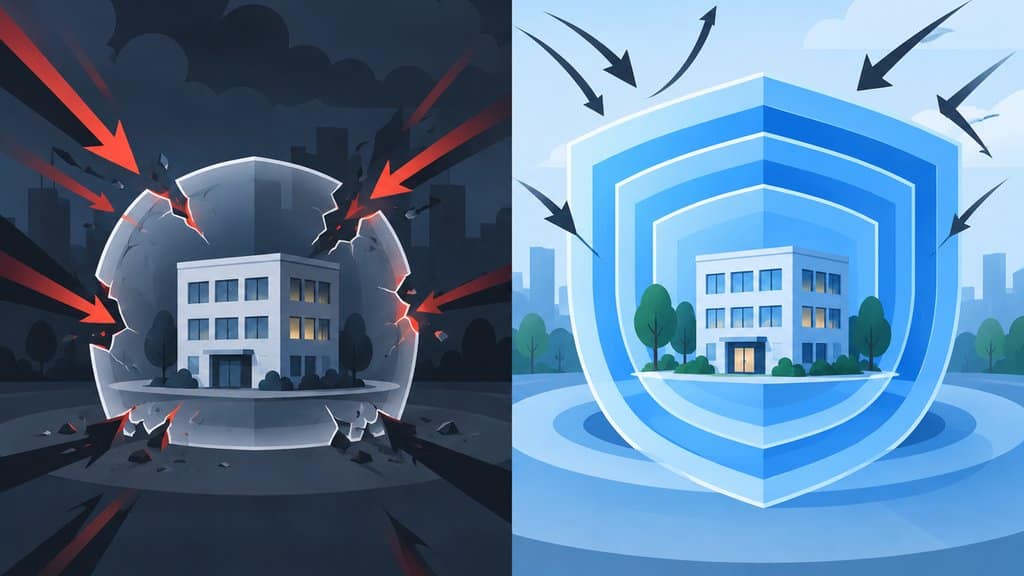
Standalone virus removal addresses the symptom but leaves the door open for reinfection. Durham-area managed IT providers typically package malware cleanup with ongoing monitoring, patch management, email filtering, and endpoint protection, creating defense in depth rather than a single point of failure.
This bundled approach matters because modern threats move laterally across networks. A provider who removes the ransomware payload from one workstation but misses the remote-access trojan on a server has not solved the problem.
Integrated security services look at the full environment.
Local Cyber Awareness and Government Security Posture
Durham’s Technology Solutions Management team includes a Cyber Security Program Manager, indicating that the city treats cybersecurity as a formal operational function rather than an afterthought. This local awareness filters into the business community through regional partnerships and information-sharing channels.
Durham County similarly maintains Information Services and Technology with dedicated security leadership. When both city and county structures invest in cybersecurity staffing, local businesses benefit from an environment where cyber risk is recognized and resourced at the institutional level.
Regional Response Coverage for Multi-Site Triangle Businesses
Providers serving Durham commonly extend coverage to Raleigh, Chapel Hill, and surrounding Research Triangle communities. For businesses with locations in multiple municipalities, or with employees working from home across the region, this geographic continuity ensures consistent response protocols and familiar technicians.
Regional coverage also matters during widespread events. When a malware campaign hits multiple local businesses simultaneously, a provider with a Triangle-wide engineer pool can scale response without leaving individual clients waiting days for attention.
What to Look for in a Durham Malware Response Partner
RCOR has served Raleigh and Durham businesses since 1992 with a support delivery system built around remote troubleshooting technology and on-site service availability. The company’s Assurance Plan offers flat-rate coverage designed to maximize network availability without the unpredictable costs of break-fix recovery.
This applies to the Help Desk service model that emphasizes follow-through and problem resolution in the shortest practical timeframe.
RCOR’s managed security services include fully managed cybersecurity, network security, cyber risk assessment, and cloud cybersecurity, alongside penetration testing for organizations that need validated proof of their defenses. The engineering team holds professional industry certifications from major technology vendors and security organizations.
Service coverage extends across the Research Triangle including Raleigh, Durham, Chapel Hill, Wake Forest, Cary, Apex, Morrisville, Hillsborough, Garner, Knightdale, and Holly Springs. RCOR offers two flat-rate plan structures: one with unlimited remote support plus eight hours of on-site service monthly, and a traditional all-inclusive option.
Endpoint Detection Strategies That Stop Infections Before They Spread
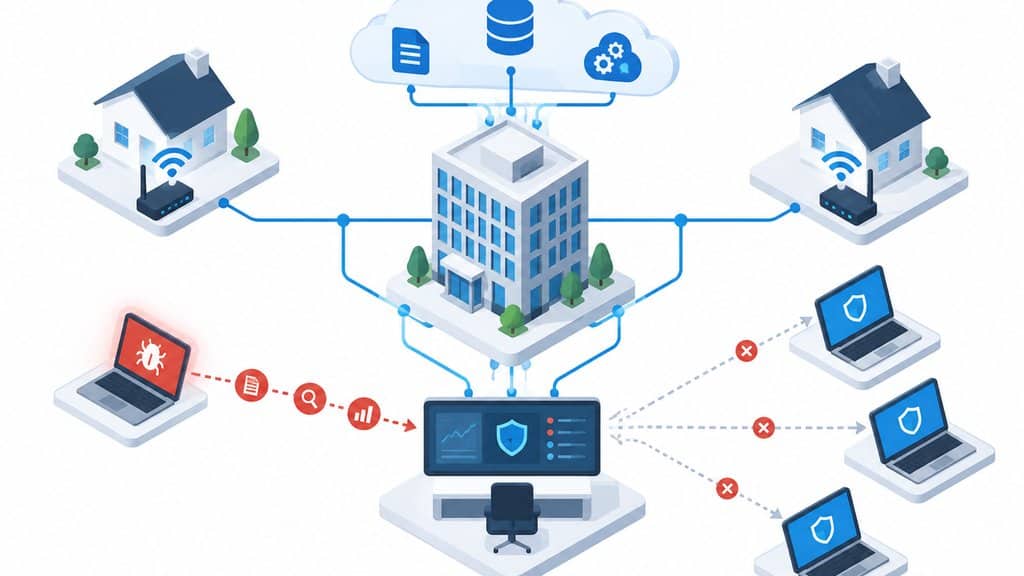
Modern malware moves fast. A single compromised laptop can infect an entire Durham office network within hours if left unchecked.
Endpoint detection and response tools monitor device behavior in real time. They flag suspicious file encryption, unusual outbound connections, and unauthorized process executions before damage accumulates.
Traditional antivirus waits for known signatures. Behavioral EDR catches zero-day threats that signature databases have never seen.
Durham businesses with hybrid workforces face expanded attack surfaces. Remote employees connecting through home routers introduce variables outside corporate firewall protection.
Centralized endpoint management lets IT teams isolate infected devices instantly. One click can quarantine a compromised machine while preserving network access for everyone else.
Regular endpoint health audits reveal shadow IT and outdated software. These gaps often serve as the entry points malware exploits most successfully.
RCOR deploys and manages EDR platforms tailored to each client’s risk profile. Configuration matters as much as the tool itself.
Email Security Gaps That Durham Businesses Overlook
Business email compromise remains the most common malware delivery method. Yet many Durham companies still rely on basic spam filters that miss sophisticated phishing campaigns.
Attackers craft messages that mimic vendors, executives, or government agencies. These socially engineered emails bypass technical filters because they contain no malicious attachments at first.
Link-based attacks have surged. A seemingly harmless document request redirects to a credential harvesting page or triggers a drive-by download.
Email authentication protocols like DMARC, DKIM, and SPF prevent domain spoofing. Implementation gaps let attackers impersonate legitimate business addresses with alarming success rates.
Attachment sandboxing detonates files in isolated environments before delivery. This extra seconds-long step blocks weaponized documents that appear normal to standard scanners.
Employee reporting channels matter. When Durham staff can flag suspicious messages with one button, security teams gain early warning of active campaigns targeting the organization.
RCOR configures layered email defenses and trains internal responders. Technical controls plus human vigilance create defense in depth against this persistent threat vector.
Post-Incident Recovery Planning for Durham Organizations
Malware removal solves the immediate problem. Recovery planning determines whether the business thrives or merely survives afterward.
Many Durham companies discover backup gaps only after ransomware strikes. Air-gapped, tested restore procedures separate resilient organizations from those facing extended downtime.
Recovery prioritization frameworks identify which systems restore first. Accounting servers, customer portals, and production equipment rarely share equal urgency.
Forensic preservation helps with insurance claims and potential law enforcement involvement. Hasty cleanup can destroy evidence needed for cyber coverage or criminal investigation.
Communication templates prepared in advance reduce crisis confusion. Customers, employees, regulators, and partners each need tailored, timely updates during an incident.
Third-party vendor dependencies extend recovery timelines. A Durham manufacturer cannot resume operations if a compromised supplier remains offline.
RCOR helps clients document, test, and refine recovery playbooks before incidents occur. Preparedness transforms chaotic response into confident execution when pressure peaks.

Frequently Asked Questions
How quickly can a Durham business get help with an active malware infection?
If that response time is not met, the work is performed at no charge. For active infections, rapid triage helps contain lateral movement before additional systems are compromised.
Does virus removal alone protect a business from future attacks?
Virus removal solves the immediate infection but does not close the entry point. Most Durham businesses benefit from bundled services that include patch management, email security, endpoint monitoring, and user awareness training to reduce repeat incidents.
What should a business do first when ransomware is detected?
Isolate affected systems immediately by disconnecting from the network, then contact your IT provider before attempting recovery. Early containment limits encryption spread and preserves forensic evidence that may identify the attack vector.
Are flat-rate IT plans available for Durham businesses concerned about unpredictable security costs?
RCOR offers two flat-rate plan options: unlimited remote support with eight hours of on-site service monthly, or a traditional all-inclusive plan. Both structures replace variable break-fix billing with predictable monthly costs.
Which Research Triangle areas does RCOR cover for malware removal and security services?
RCOR serves Raleigh, Durham, Chapel Hill, Wake Forest, Cary, Apex, Morrisville, Hillsborough, Garner, Knightdale, and Holly Springs with both remote and on-site support capabilities.
How does RCOR verify that malware has been completely eliminated from a Durham business network?
RCOR conducts multi-layered verification after removal, including secondary scanning with independent tools, network traffic analysis for command-and-control beacons, and endpoint forensics to confirm no persistent backdoors remain. We provide documentation of findings and recommend ongoing monitoring to catch any residual threats that surface after initial cleanup.