
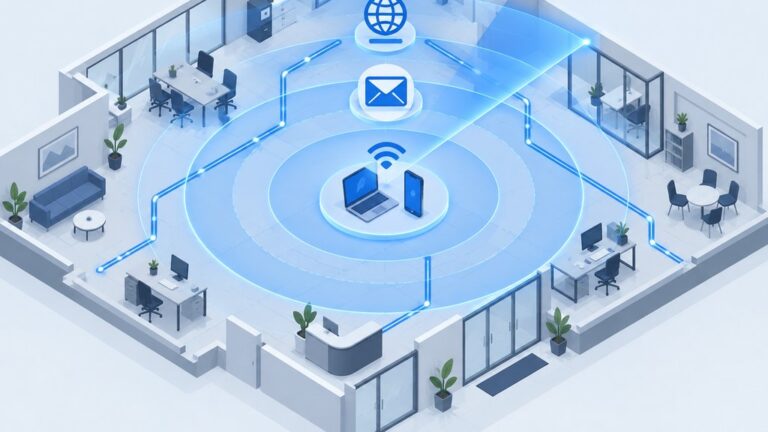
Cyber threats do not wait for business hours, and for companies in Durham, NC, the cost of a delayed response can stretch well beyond the IT budget. Understanding what threat detection actually covers, and how local providers structure their services, helps business leaders make informed decisions about protection without overpaying for capabilities they do not need.
This article breaks down the core components of modern threat detection, explains how each layer works, and provides a research-backed checklist that Durham businesses can use to evaluate their current posture or compare managed security options.
Key Takeaways
- Threat detection combines automated monitoring, vulnerability scanning, and human-led threat hunting to catch attacker activity that basic controls miss.
- Endpoint and email security form the baseline for most Durham managed-security offerings, with continuous monitoring layered on top.
- North Carolina directs private-sector entities to report cybersecurity incidents through a statewide process, making incident-response planning a compliance-relevant practice.
- 24/7 coverage matters because many intrusions begin outside business hours when internal teams are offline and response delays compound damage.
What threat detection covers beyond antivirus
Traditional antivirus looks for known malware signatures, but modern threat detection in Durham, NC goes further by monitoring behavior, network traffic, and user activity for signs of compromise. This broader approach catches fileless attacks, credential misuse, and lateral movement that signature-based tools often miss.
The shift from prevention-only to detect-and-respond reflects how attackers now operate: they use stolen credentials, legitimate tools, and patience to avoid triggering basic alerts. A detection program watches for the subtle anomalies that indicate someone is already inside the environment.
As attackers develop more sophisticated methods, business leaders should stay informed about New Technology Threats In 2025 Beware and adjust their detection strategies accordingly.
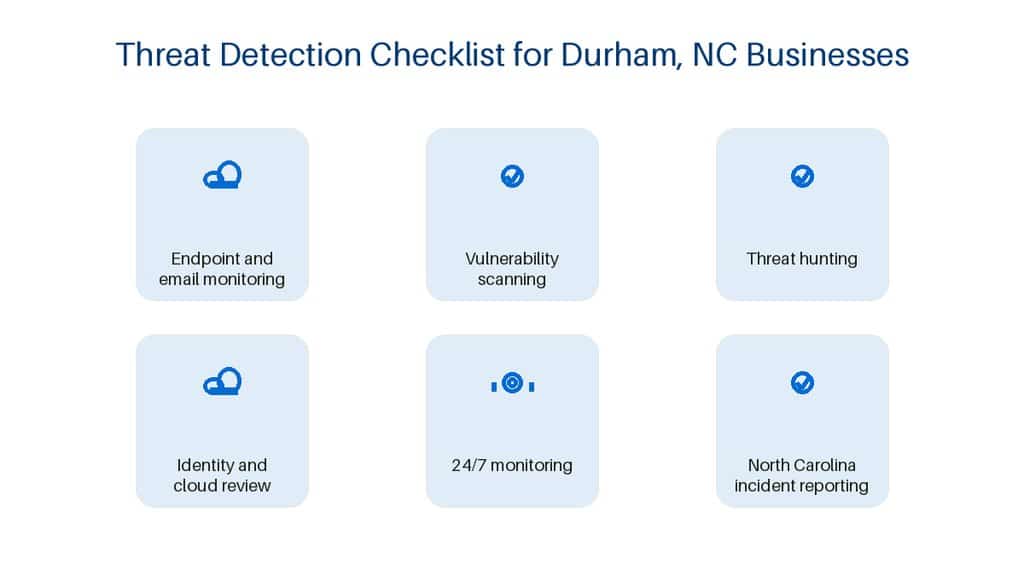
Threat Detection Checklist for Durham, NC Businesses
- ✓Endpoint and email monitoring: Required baseline: endpoint protection/detection and response plus email security and continuous monitoring
- ✓Vulnerability scanning: Include in recurring reviews: identify exploitable weaknesses before attackers use them
- ✓Threat hunting: Escalation capability: human-led search for attacker activity that automated controls may miss
- ✓Identity and cloud review: Investigate privileged access: monitor cloud and identity as part of detection and investigation
- ✓24/7 monitoring: Continuous coverage: around-the-clock threat monitoring and incident response availability
- ✓North Carolina incident reporting: Statewide reporting form: private-sector entities use the official cybersecurity incident-reporting process
Based on service descriptions and guidance applicable to Durham, NC businesses.
Endpoint and email monitoring as the required baseline
Endpoint protection and detection and response, paired with email security and continuous monitoring, represent the foundational layer that Durham managed-security providers commonly include. Endpoints are where users click links, open attachments, and run applications, making them the most frequent entry point for attacks.
Email remains the primary delivery method for phishing, business email compromise, and malware distribution. Monitoring both the endpoint and the mail flow creates overlapping visibility: if a malicious email slips through, the endpoint layer may still catch the resulting behavior.
Why vulnerability scanning belongs in recurring reviews
A practical threat-detection baseline for Durham businesses should include vulnerability scanning to identify exploitable weaknesses before attackers use them. Unpatched software, misconfigured cloud storage, and exposed remote-access tools create footholds that detection systems may not notice until after compromise.
Scanning on a recurring schedule, rather than as a one-time project, matters because new vulnerabilities are disclosed continuously and configuration drift happens as staff make changes. The goal is to shrink the window between a weakness appearing and it being remediated or monitored more closely.
Threat hunting as an escalation capability
Threat hunting supplements automated alerts by looking for attacker activity that controls may miss, and it is identified as a service for Durham matters where the stakes warrant deeper investigation. Automated systems generate noise and miss subtle tactics, especially when adversaries use living-off-the-land techniques with native tools.
Human hunters apply hypotheses about attacker behavior to datasets that rules-based systems do not examine, such as unusual authentication patterns or unexpected data staging. This capability sits above baseline monitoring and responds when indicators suggest a more sophisticated or persistent adversary.

Identity and cloud review for privileged access risks
Durham incident-response services include cloud and identity review, making access monitoring an important part of threat detection and investigation. Compromised privileged accounts allow attackers to move laterally, escalate permissions, and persist in environments for months without triggering traditional malware alerts.
Cloud platforms introduce additional complexity because identity is often the primary perimeter, and misconfigurations in access policies can expose data directly. Reviewing who has access, how credentials are protected, and whether multi-factor authentication is enforced closes gaps that monitoring alone cannot address.
Continuous coverage and state incident reporting requirements
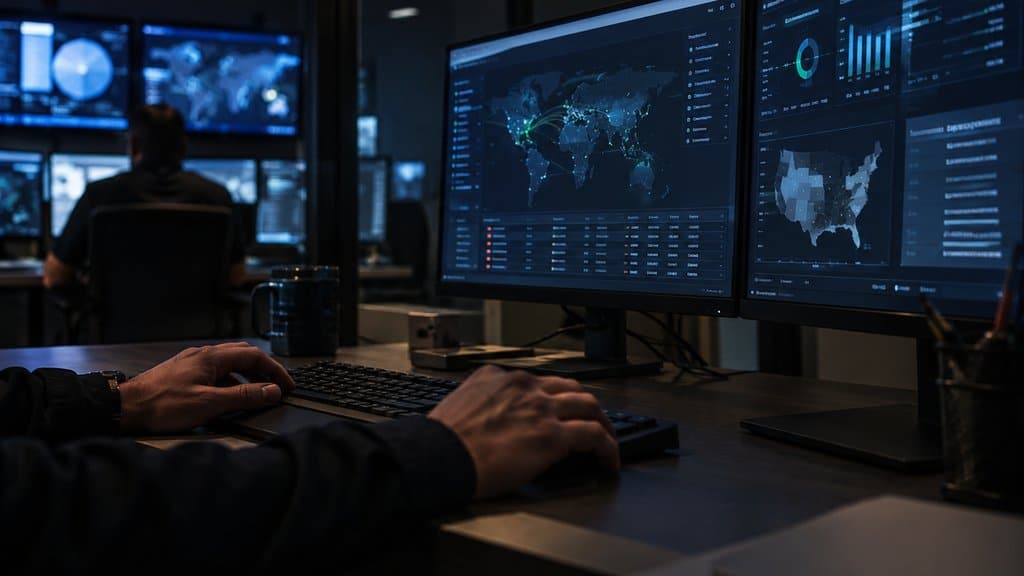
Regional providers serving Durham advertise 24/7 threat monitoring and incident response for organizations that need coverage beyond business hours. Attack timing is not random: many intrusions begin during nights or weekends when detection might be slower and response staff are off duty.
Organizations that want to understand how continuous monitoring and expert analysis translate into measurable protection should review the latest Soc Benefits shaping enterprise security strategy in 2025.
North Carolina directs private-sector entities and other listed organizations to use the statewide cybersecurity incident-reporting process. Knowing this requirement in advance helps businesses prepare documentation, establish communication chains, and align their detection program with what regulators expect after a confirmed breach.
How RCOR structures managed security for Durham businesses
RCOR has served local businesses across Raleigh and Durham since 1992, specializing in enterprise-class network support for companies with small-company IT budgets. The company offers managed security services as a core offering, alongside managed IT services, cybersecurity and compliance, penetration testing, and backup and disaster recovery.
Businesses that want a broader view of protection can explore Site:rcor.com for managed cybersecurity services that integrate threat detection with ongoing defense and compliance support.
RCOR provides a Help Desk service model that maximizes responsiveness and ensures follow-through, along with on-site service availability and a company culture focused on solving technical problems in the shortest time and cost-effective to customers. The team includes certified engineers with professional industry certifications from major technology vendors and security organizations, and RCOR offers two flat-rate plans designed to lower costs with predictable monthly fees.
Network traffic analysis for behavioral anomalies
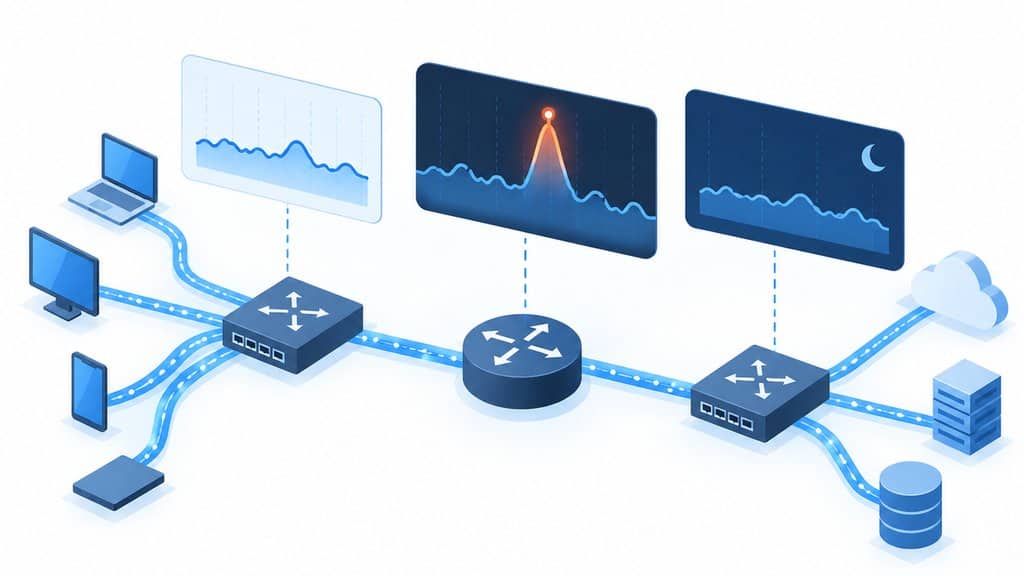
Network traffic analysis reveals patterns that signature-based tools miss entirely. It examines flow data, connection timing, and volume shifts to spot irregularities.
East Durham manufacturers often see unexpected data transfers during off-hours. This behavioral signal frequently indicates command-and-control communication or reconnaissance activity.
NetFlow and similar protocols capture metadata without inspecting payload content. This approach preserves performance while still exposing lateral movement and beaconing behaviors.
RCOR configures baseline profiles for each Durham client’s normal operations. Deviations trigger analyst review rather than noisy alerts that staff learn to ignore.
Seasonal businesses near Duke University experience legitimate traffic fluctuations. The analysis engine accounts for enrollment cycles, research deadlines, and athletic events.
Encrypted traffic poses a growing challenge for traditional inspection methods. Metadata analysis of TLS handshakes and certificate characteristics still exposes many threats.
Integration with endpoint data creates correlated visibility across the environment. Isolated network alerts gain context that separates genuine incidents from benign anomalies.
Third-party and supply chain risk monitoring
Durham’s research corridor creates dense interconnection between organizations. A compromise at one partner can cascade through shared credentials, VPN access, or file exchanges.
Vendor risk assessments often remain static documents gathered during onboarding. Continuous monitoring validates that security postures do not degrade after contracts are signed.
RCOR tracks security ratings and breach disclosures for critical suppliers. Sudden score drops or dark web mentions prompt immediate client notification.
Software supply chain attacks target trusted update mechanisms. Verification of code signatures and hash values catches tampered patches before deployment.
Local biotech firms frequently collaborate with international research partners. Geographic risk factors and data sovereignty requirements shape monitoring priorities.
Fourth-party exposure extends beyond direct vendor relationships. Mapping this extended ecosystem prevents blind spots in dependency chains.
Contractual security requirements mean little without verification mechanisms. Automated evidence collection demonstrates compliance without burdening internal teams.
Detection engineering and rule tuning for local threat landscapes
Generic detection rules produce overwhelming false positive rates. Tuned rules reflect the specific applications, user behaviors, and risk profiles of Durham operations.
RCOR maintains detection libraries segmented by industry vertical. Healthcare rules emphasize PHI access patterns while manufacturing rules focus on operational technology interfaces.
Threat intelligence feeds require careful curation and contextualization. Indicators relevant to financial services may distract from risks actually facing Triangle-area nonprofits.
Red team exercises validate that detection mechanisms trigger appropriately. Gaps between expected and actual coverage drive prioritized engineering sprints.
Student populations at nearby institutions create unique insider risk patterns. Seasonal account provisioning and research data handling need tailored monitoring approaches.
Detection engineering is not a one-time configuration effort. Adversary techniques evolve, and rule effectiveness degrades without continuous refinement.
Metric-driven tuning uses mean time to detect and false positive ratios. These measurements guide resource allocation toward the highest-impact detection improvements.
Frequently Asked Questions
What is the minimum threat detection capability a Durham business should have?
Endpoint and email monitoring with continuous coverage forms the practical minimum. Vulnerability scanning should follow quickly, and businesses handling sensitive data or subject to compliance requirements should evaluate threat hunting and identity review as well.
How does 24/7 monitoring differ from automated alerting?
Automated alerting sends notifications when rules fire, but 24/7 monitoring means trained analysts are watching, validating, and escalating around the clock. The human layer reduces false positives and catches subtle patterns that automation alone misses.
What should a business do after detecting a potential security incident?
Contain the affected systems to prevent spread, preserve logs and evidence for investigation, and notify relevant parties including your managed security provider. North Carolina also directs private-sector entities to use the statewide cybersecurity incident-reporting process.
How often should vulnerability scanning run?
Monthly or quarterly scanning is typical for most businesses, with more frequent scans for environments that change rapidly or host critical data. The key is matching scan frequency to the rate of change and the risk of exposed systems.
Can a small business in Durham afford enterprise-grade threat detection?
Managed security providers like RCOR specialize in delivering enterprise-class support to businesses with small-company IT budgets. Flat-rate plans spread costs predictably, and the right provider tailines the stack so you pay for what you need rather than an oversized platform.
What is the difference between threat detection and incident response?
Threat detection is the ongoing process of identifying suspicious or malicious activity. Incident response is the structured reaction to a confirmed breach, including containment, eradication, recovery, and lessons learned.
The two work together, but detection must come first.

About the author
Tim Richter - Co-Founder / President
Tim Richter is Co-Founder and President of RCOR, a managed IT and cybersecurity firm that has been serving businesses across Raleigh and Durham since 1992. He brings more than 35 years in the IT industry and today leads a team providing enterprise-class network support to small and mid-sized organizations throughout the Research Triangle.