

Cybersecurity is no longer a concern reserved for Fortune 500 companies with dedicated security operations centers. Small and mid-size businesses in Durham, NC face the same phishing campaigns, ransomware threats, and compliance pressures as larger organizations, but often without the internal resources to respond effectively.
This guide explains what managed IT security actually covers, which capabilities matter most for businesses with fewer than 100 network users, and how to evaluate a provider that understands the specific risks facing organizations in the Raleigh-Durham area.
Key Takeaways
- Managed IT security combines continuous monitoring, threat detection, incident response, and compliance support under a single service relationship.
- A provider’s response-time commitment and remedy for missed targets reveals more about operational maturity than any marketing claim.
- Flat-rate pricing models help small businesses budget predictably while receiving enterprise-class security coverage.
- Security awareness training and phishing simulations reduce human-error incidents, which remain a leading cause of successful breaches.
How Managed IT Security Differs from Basic IT Support
Traditional IT support fixes what breaks: a failed drive, a password reset, a printer that will not connect. Managed IT security, by contrast, operates on a prevention and detection model that looks for anomalies before they become outages or breaches.
The distinction matters for Durham businesses because a security incident can halt operations for days, trigger regulatory notification requirements, and damage client trust in ways that a routine hardware failure does not. A managed security service layers continuous monitoring, vulnerability management, and incident response planning on top of standard infrastructure support.
For organizations with small IT budgets, this layered approach is often delivered through a managed service provider that maintains a pool of engineers with professional industry certifications from major technology vendors and security organizations. The provider spreads specialized expertise across multiple clients, making enterprise-class capabilities accessible at a predictable monthly cost.
Managed IT Security Provider Checklist for Durham Businesses
- ✓Continuous security monitoring and alerting: Recommended practice
- ✓Documented incident response plan with defined roles: Recommended practice
- ✓Vulnerability scanning with prioritized remediation scheduling: Recommended practice
- ✓Multi-factor authentication and least-privilege access policies: Recommended practice
- ✓Security awareness training with phishing simulation: Recommended practice
- ✓Endpoint detection and response beyond traditional antivirus: Recommended practice
- ✓Cloud application security configuration and monitoring: Recommended practice
- ✓Compliance mapping to applicable regulatory frameworks: Recommended practice
- ✓Immutable backup with tested restoration procedures: Recommended practice
- ✓Flat-rate monthly pricing option: Available from RCOR
- ✓: Available from RCOR
- ✓Onsite service availability when remote resolution is insufficient: Available from RCOR
Security capabilities marked as recommended practice align with guidance from the National Institute of Standards and Technology. Service commitments reflect RCOR’s published Assurance Plan terms.
Core Security Capabilities to Evaluate
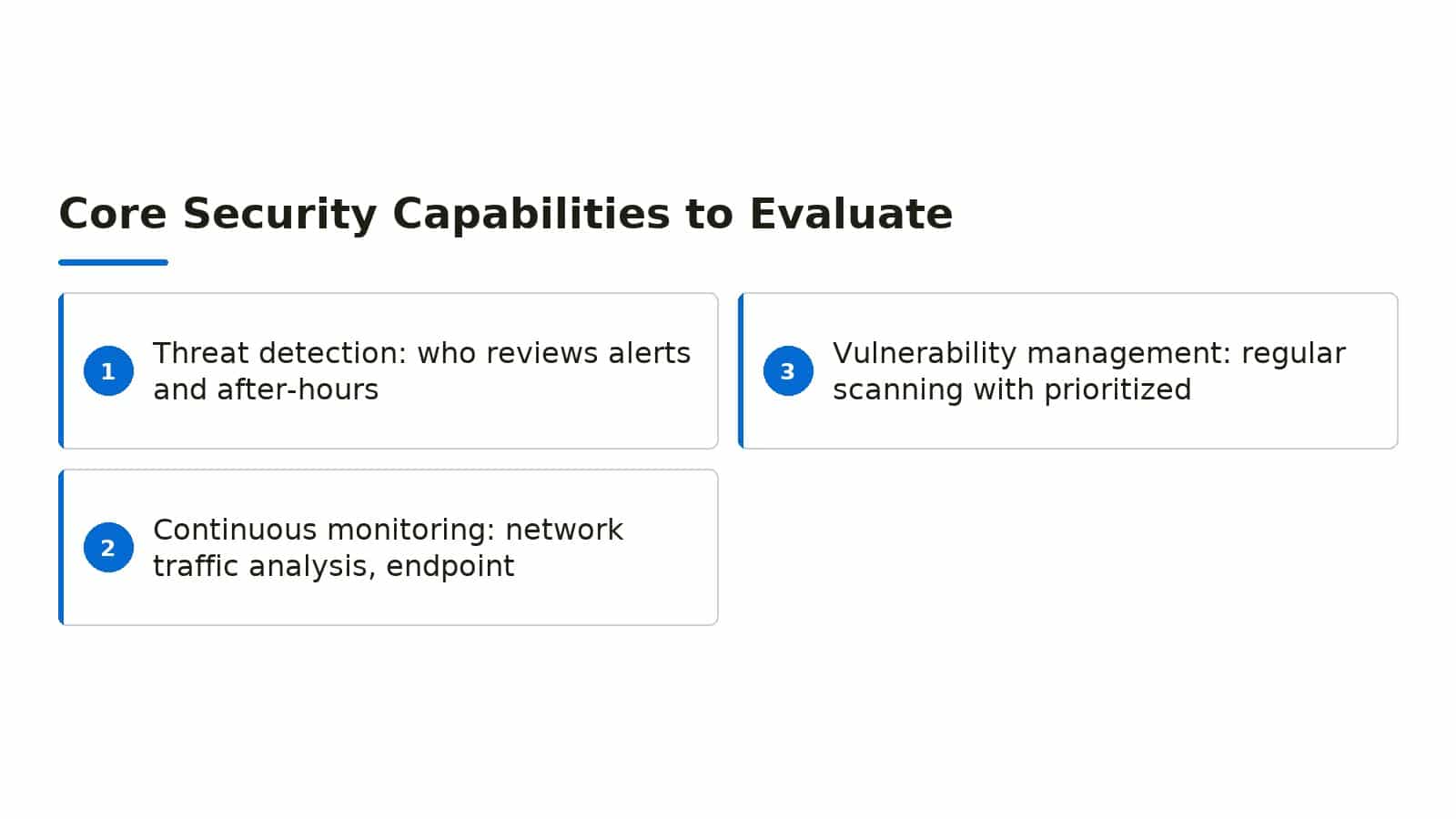
When reviewing managed IT security offerings, focus on operational specifics rather than generic promises. Ask how threat detection works, who reviews alerts, and what happens when a potential incident triggers after business hours.
Continuous monitoring should include network traffic analysis, endpoint behavior monitoring, and log correlation across cloud and on-premises environments. The goal is to identify patterns that suggest unauthorized access, malware activity, or data exfiltration before significant damage occurs.
Vulnerability management is equally critical. This means regular scanning of systems and applications, prioritized remediation based on actual exploitability and business impact, and clear reporting that shows what was found, what was fixed, and what risks remain acceptable.
Access control capabilities should cover multi-factor authentication implementation, role-based permissions that follow least-privilege principles, and periodic review of user accounts and privileges as staff change roles or leave the organization.
Incident Response and Recovery Planning
Even well-defended organizations experience security events. The difference between a contained incident and a headline-making breach often comes down to preparation and response speed.
A managed security provider should deliver a documented incident response plan that defines roles, escalation paths, communication protocols, and containment procedures. The plan should be tested periodically through tabletop exercises or simulated scenarios, not simply written and filed away.
Recovery capabilities matter just as much. Backup and disaster recovery services should include immutable backups that ransomware cannot encrypt, tested restoration procedures, and recovery time objectives that match your business’s actual tolerance for downtime.
Some providers offer a response-time commitment with a remedy if targets are missed. This operational accountability indicates a mature service model that prioritizes follow-through over promises.

Compliance and Regulatory Considerations for Durham Businesses
Organizations in healthcare, financial services, and certain professional sectors face specific regulatory frameworks that shape their security obligations. Healthcare providers must account for HIPAA security and privacy rules.
Financial services firms navigate GLBA requirements. Organizations that process payment cards need PCI-DSS controls.
A managed security provider should help map technical controls to applicable regulatory requirements, not simply assert generic compliance. This mapping should be documented, reviewed with your legal or compliance advisor, and updated as regulations or your business operations change.
For Durham businesses connected to research institutions or federal funding streams, additional considerations around controlled unclassified information or export-controlled data may apply. The right provider asks these questions during onboarding rather than discovering gaps during an audit.
Security awareness training with phishing simulation supports compliance efforts while reducing the human-error incidents that bypass even sophisticated technical controls. Employees who recognize social engineering attempts become an active defense layer rather than a vulnerability.

Cloud and Collaboration Security
Most Durham businesses now rely on cloud applications for email, document collaboration, and communication. These environments introduce security considerations distinct from traditional on-premises infrastructure.
Cloud application security should cover configuration hardening, data loss prevention policies, and monitoring for anomalous access patterns. For organizations using Microsoft 365, this includes proper tenant configuration, conditional access policies, and protection against business email compromise attacks.
Microsoft Teams deployments require attention to guest access controls, channel permissions, and integration security with other applications. A provider that helps businesses deploy, configure, and manage Microsoft Teams with security and compliance policies in place reduces the risk of accidental data exposure through misconfigured collaboration spaces.
The shift to cloud and hybrid environments means security boundaries have moved from network perimeters to identity and data-centric controls. Your managed security provider should demonstrate expertise in both traditional network security and modern cloud-native protection strategies.
How RCOR Delivers Managed IT Security to Raleigh-Durham Businesses
RCOR has served local businesses across Raleigh and Durham since 1992, specializing in enterprise-class network support for organizations with small-company IT budgets. The company has developed a unique support delivery system that includes a low overhead but tightly connected virtual office infrastructure, sophisticated remote troubleshooting technology, and a pool of engineers with professional industry certifications from major technology vendors and security organizations.
RCOR’s Assurance Plan is designed to maximize computer and network availability at one low monthly cost, with two flat-rate plan options available: unlimited remote support with eight hours of onsite service per month, or a traditional all-inclusive arrangement.
The Help Desk service model emphasizes responsiveness and follow-through, with on-site service availability when remote resolution is not sufficient. RCOR’s managed security services include fully managed cybersecurity, network security, cyber risk assessment, and cloud cybersecurity, along with penetration testing to identify vulnerabilities before attackers do.
For businesses using Microsoft 365 and Microsoft Teams, RCOR provides deployment, configuration, and ongoing management with security and compliance policies tailored to each organization’s needs. Backup and disaster recovery services complement the security portfolio, ensuring that protected data can be restored when needed.

Frequently Asked Questions
What is the difference between managed IT services and managed IT security?
Managed IT services cover the full range of technology support: infrastructure maintenance, user support, software updates, and network management. Managed IT security is a focused subset that addresses threat detection, vulnerability management, incident response, and compliance.
Many providers bundle both, but the security components require specialized tools and expertise distinct from general IT support.
How quickly should a managed security provider respond to a potential incident?
Response expectations should be documented in your service agreement. Faster response times for critical severity incidents are worth discussing during provider evaluation.
Do small businesses in Durham really need enterprise-class security?
Cybercriminals target organizations based on opportunity and vulnerability, not size. Small and mid-size businesses often present attractive targets because they may lack dedicated security staff while still holding valuable data and financial resources.
Enterprise-class security delivered through a managed service provider makes advanced protection accessible without requiring internal specialization.
What should I ask a potential managed security provider about compliance?
Ask which regulatory frameworks they have experience with, how they map technical controls to specific requirements, and whether their documentation has passed third-party audit review. Request examples of how they have helped similar businesses prepare for compliance assessments.
Be specific about which regulations apply to your industry and whether you handle data subject to special protections.
How does flat-rate pricing work for managed security services?
Flat-rate pricing replaces unpredictable hourly billing with a fixed monthly cost based on your environment’s size and complexity. RCOR offers two flat-rate plans: unlimited remote support with eight hours of onsite service per month, or a traditional all-inclusive arrangement.
This predictability helps small businesses budget effectively while receiving comprehensive coverage.
What cloud security capabilities should I expect from a managed security provider?
Expect configuration review and hardening for your cloud tenants, data loss prevention policies, conditional access and multi-factor authentication implementation, and ongoing monitoring for anomalous access or data movement. If you use Microsoft 365 and Microsoft Teams, the provider should demonstrate specific expertise in securing these platforms against business email compromise and misconfiguration risks.

About the author
Tim Richter - Co-Founder / President
Tim Richter is Co-Founder and President of RCOR, a managed IT and cybersecurity firm that has been serving businesses across Raleigh and Durham since 1992. He brings more than 35 years in the IT industry and today leads a team providing enterprise-class network support to small and mid-sized organizations throughout the Research Triangle.